Bitcoin Mining Stocks Mirror Market Trends
Discover why Bitcoin mining stocks follow broader market trends and what this means for investors navigating today’s digital asset landscape.

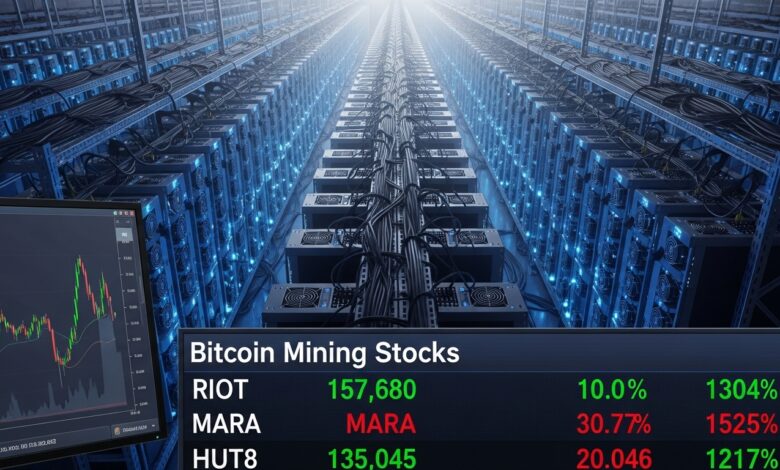
In the early days of cryptocurrency, Bitcoin mining stocks were obscure, speculative assets followed mostly by niche investors fascinated by blockchain technology. Over time, however, Bitcoin mining companies have evolved into publicly traded enterprises listed on major exchanges.
Their increased visibility and integration into mainstream markets have sparked a new conversation about how these companies behave in relation to traditional financial markets. One notable trend stands out above all: Bitcoin mining stocks often track broader market moves, even when Bitcoin itself appears to be following a different trajectory.
This may seem counterintuitive at first. Bitcoin miners, after all, generate revenue directly from block rewards and transaction fees. Their cost structures revolve around energy prices, hardware efficiency and operational scale. The price of Bitcoin affects their profitability more than any other variable. Yet, the deeper these companies embed themselves into the institutional and retail investment universe, the more their performance begins to mimic that of high-growth technology stocks.
The phenomenon raises several pressing questions. Why do Bitcoin mining equities respond so dramatically to market-wide sentiment? What causes them to decouple at times from Bitcoin’s price? And what can investors learn from these movements as they navigate an increasingly complex digital-asset ecosystem? By examining the interplay between macroeconomic forces, investor psychology and business model evolution, we gain a clearer picture of why Bitcoin mining stocks track broader market movements and what this means for the future of the industry.
How Bitcoin Mining Stocks Behave in Real Market Conditions
Miners as a Natural Leveraged Play on Bitcoin
Bitcoin miners earn BTC, making their revenue structure naturally dependent on the cryptocurrency’s market price. When Bitcoin rallies, the value of mined coins increases, often boosting a miner’s income at a much faster rate than Bitcoin itself appreciates.
This dynamic effectively makes mining companies a leveraged proxy for Bitcoin exposure. Investors who want amplified upside during bull cycles may therefore gravitate toward mining stocks, expecting them to surge when enthusiasm for cryptocurrency grows.
However, this built-in leverage becomes a double-edged sword. In periods of Bitcoin weakness, mining revenues contract almost instantly. Operating costs, particularly energy expenditures and maintenance of high-performance computing equipment, remain fixed or even increase, squeezing profit margins. As a result, mining stocks may decline even more sharply than Bitcoin during market downturns.
This asymmetric volatility demonstrates that Bitcoin mining stocks inhabit a unique intersection between cryptocurrency markets and the equity world. They are neither purely digital assets nor traditional businesses, but a hybrid that carries risk from both domains.
The Increasing Correlation Between Crypto and Equities
In recent years, the correlation between Bitcoin and major indices such as the S&P 500, Nasdaq, and global tech benchmarks has strengthened. Bitcoin was once described as “digital gold,” a store of value intended to hedge against economic instability. Yet, in practice, it often behaves more like a high-beta risk asset strongly influenced by macroeconomic conditions.
As institutional interest in Bitcoin grew, particularly through hedge funds, corporate treasuries, asset managers and Bitcoin ETFs, capital flows between the crypto world and mainstream equities became more fluid. When global risk appetite expands, both speculative tech stocks and cryptocurrencies tend to outperform. When risk aversion sets in, both decline as investors rotate into safer assets.
Bitcoin mining stocks amplify this dynamic. Their position in equity markets exposes them to valuation pressures, liquidity cycles and investor sentiment that move independently of Bitcoin’s blockchain fundamentals. The more they integrate into technology-driven portfolios, thematic ETFs and institutional holdings, the more their price behavior resembles that of broader market indices.
Why Bitcoin Mining Stocks Track Broader Market Moves
Market Sentiment and Growth-Stock Behavior
Bitcoin mining companies share several traits with high-growth technology firms, including aggressive expansion strategies, heavy capital expenditure requirements and reliance on favorable macroeconomic conditions. Investors often cluster them with speculative tech stocks, cloud-computing players and emerging-market innovators. This categorization means that when markets enter a risk-on environment, capital flows into similar asset classes, lifting mining stocks alongside unrelated growth sectors.
During risk-off phases, however, mining equities tend to fall rapidly, sometimes even faster than the broader market. Investors facing uncertainty may liquidate riskier assets first, and Bitcoin miners frequently fall into that category due to their volatility and exposure to Bitcoin’s price swings. Because mining companies operate under thin margins that can erode quickly in challenging conditions, they appear to equity investors as particularly vulnerable during downturns.
This makes market sentiment one of the strongest external forces guiding Bitcoin mining stock performance. Even when Bitcoin maintains relative stability, miners can experience large fluctuations driven by shifting expectations in the broader financial environment.
The Role of Interest Rates, Liquidity and Regulatory Conditions
Central bank policies, especially those related to interest rates and liquidity, hold significant influence over Bitcoin mining stocks. Low interest rates encourage borrowing, expansion and aggressive investment strategies. Miners often depend on debt financing or equity offerings to build new facilities, upgrade hardware and secure long-term energy contracts.
When interest rates rise, financing becomes more expensive and future earnings get discounted more heavily. Mining companies, which already operate with high fixed costs, see their valuations shrink. This effect mirrors the challenges faced by growth companies reliant on projected future profits.
Regulation is another factor connecting mining equities to broader market moves. Supportive rulings—such as approvals for Bitcoin ETFs, favorable energy policies or clear tax guidelines—improve investor confidence and lift both Bitcoin and mining stocks. Restrictive actions, including crackdowns on mining operations, increased reporting requirements or environmental regulations, can depress valuations and create uncertainty in both crypto and equity markets.
When Bitcoin Mining Stocks Diverge from Bitcoin
The Shift Toward Digital Infrastructure and AI Integration
One of the most compelling developments in the sector is the gradual transformation of mining companies from pure-play Bitcoin producers into diversified digital-infrastructure operators. Many miners are now allocating portions of their power supply and data-center capacity to artificial intelligence, high-performance computing and cloud services. These areas represent fast-growing industries with more predictable revenues than Bitcoin mining alone.
As miners evolve, the stock market may begin valuing them using metrics more commonly applied to data-center companies and cloud-infrastructure providers. When this happens, their share prices can diverge substantially from Bitcoin’s movements. Even if Bitcoin trades sideways, mining stocks that are successfully transitioning into AI-focused or energy-infrastructure roles may appreciate on the strength of new revenue channels.
This shift reveals how the identity of Bitcoin miners is broadening. They are no longer simply producing cryptocurrency; they are becoming part of the backbone of the digital economy, with roles that overlap green energy, computing power and next-generation technology services.
Differentiation Through Cost Efficiencies and Financial Strategies
Another reason mining stocks sometimes stray from Bitcoin’s price movements lies in the individual characteristics of each company. Factors such as energy pricing, operational efficiency, hardware performance, treasury management and capital structure vary widely across the industry.
Miners with low-cost energy contracts or renewable power agreements may remain profitable even when Bitcoin prices dip. Their stock prices may therefore hold up better during Bitcoin downturns. Companies that invest early in next-generation ASICs or innovative cooling systems may produce Bitcoin more efficiently than competitors, improving margins and attracting investor confidence.
Financial strategies also play a crucial role. Some miners hedge their Bitcoin exposure or maintain strategic reserves of mined coins. Others use debt aggressively to scale operations, a choice that increases risk when market conditions tighten. The presence or absence of these strategies influences how investors perceive each company, allowing certain mining stocks to move independently of Bitcoin during specific market cycles.
Implications for Investors Navigating Mining Stocks

Understanding the Multi-Layered Volatility
Investors considering Bitcoin mining equities should understand that these assets reflect multiple layers of volatility. First, they inherit Bitcoin’s inherent price fluctuations. Second, they inherit the volatility of equity markets, which can react strongly to macroeconomic data, geopolitical events and policy decisions. The result is a complex risk profile combining two highly dynamic financial environments.
During bull markets, this layered volatility can lead to explosive upside. Mining stocks often outperform Bitcoin itself as institutional funds, retail investors and speculative traders flood into the sector. Yet in bear markets, the combination of cryptocurrency downturns and equity market stress can cause mining stocks to decline more sharply than either asset class alone.
Position Sizing, Time Horizon and Strategy
Investors often treat mining stocks as complements to direct Bitcoin exposure rather than replacements for holding the cryptocurrency. A balanced approach considers the role mining equities play within a broader portfolio that may include traditional stocks, bonds, digital assets or thematic investments.
Since mining stocks respond quickly to shifts in sentiment, investors with longer time horizons typically fare better. They can ride out cycles, halvings and technological upgrades that influence the industry’s profitability. Those looking for short-term gains may find the volatility overwhelming.
Diversification across multiple miners, or combining miners with direct Bitcoin holdings, can help smooth performance while retaining exposure to the growing digital-asset economy.
See More: Bitcoin Plummets in October as Altcoins Show Resilience
The Future Outlook: Halvings, Innovation and Institutional Growth
Bitcoin Halving Events and Their Industry Impact
Bitcoin halving events reduce the block reward by 50 percent, instantly reshaping profit margins for miners. Historically, these events have created periods of uncertainty followed by renewed bullish momentum as Bitcoin supply tightens. Miners with efficient operations often emerge stronger in the post-halving landscape, while less efficient competitors may struggle or withdraw from the market.
Future halving cycles are expected to intensify the need for operational excellence. As rewards diminish, miners will increasingly rely on cost efficiencies, alternative revenue streams and strategic innovation. Companies investing in AI integration, green energy solutions and diversified data-center services may gain an edge that insulates them from pure Bitcoin price dependency.
The Rising Importance of Sustainability and ESG Compliance
Sustainability has become a central theme in modern financial markets. Bitcoin miners, particularly large publicly traded companies, face significant scrutiny regarding their energy sources and carbon footprints. Many companies now promote their use of renewable energy, including hydro, wind, solar and geothermal power, to demonstrate their commitment to environmentally responsible operations.
Investors are increasingly aware of ESG considerations, and mining companies that proactively address these concerns may attract more institutional capital. In some cases, miners operating entirely on renewable energy have already begun differentiating themselves, achieving higher valuations independent of short-term Bitcoin price action.
Institutional Integration and Market Maturity
As Bitcoin continues to mature as an asset class, mining companies are becoming entrenched components of institutional investment strategies. The introduction of spot Bitcoin ETFs, increased regulatory clarity and a more developed crypto-financial ecosystem have brought mining stocks into mainstream financial discourse.
Mining companies may eventually join broader technology and clean-energy indices, reinforcing their connection to traditional markets while expanding their investor base. Their dual positioning—as both crypto-infrastructure players and emerging data-center innovators—will continue shaping how they trade relative to Bitcoin and the stock market as a whole.
Conclusion
Bitcoin mining stocks hold a distinctive and evolving place in the global financial ecosystem. They are connected to Bitcoin through their core operations yet influenced by the equity market’s macroeconomic forces. This dual identity explains why Bitcoin mining stocks track broader market moves, responding to sentiment, liquidity, regulatory developments and technological trends that extend well beyond Bitcoin itself.
For investors, understanding this relationship is essential. Mining equities are not simply a different way to buy Bitcoin. They are high-beta, hybrid assets shaped by both cryptocurrency fundamentals and traditional market dynamics. Their volatility can be advantageous in bull markets and challenging in downturns, making informed strategy and long-term thinking vital.
As the digital asset sector expands, mining companies will continue to evolve, increasingly becoming diversified infrastructure providers at the intersection of blockchain, AI and renewable energy. Their future performance will likely reflect this transformation, offering new opportunities and challenges for those seeking exposure to the broader world of digital innovation.