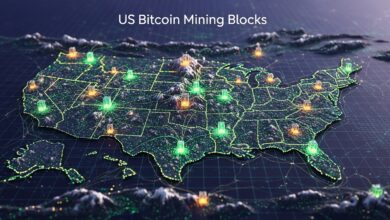
America Losing Ground in Bitcoin Mining
America’s Bitcoin mining lead is slipping as rivals surge, power costs rise, and policy clashes grow—despite Trump’s push for U.S. dominance.

For a few short years after China’s 2021 crackdown, the United States looked like the inevitable center of gravity for Bitcoin mining. Publicly listed miners expanded aggressively, new industrial sites plugged into deregulated power markets, and a growing ecosystem of North American service providers made it easier to finance, build, and operate at scale. Headlines about America “winning” Bitcoin mining became common, reinforced by the rise of large U.S.-based pools and the visibility of miners on Wall Street.
Yet dominance in Bitcoin mining is never a permanent achievement. It’s a moving target shaped by cheap energy, political tolerance, hardware supply chains, and the relentless mathematics of proof-of-work. Over the last year, multiple datasets and industry reports have pointed to a more complicated picture: while the U.S. remains a top hub, its relative grip on Bitcoin mining has started to loosen as competing regions add capacity, restructure energy deals, and attract capital. A recent industry narrative has sharpened around that shift—North America’s share of newly minted bitcoin isn’t as commanding as it once looked, even as pro-crypto political messaging grows louder.
This tension sits at the heart of today’s debate. On one side is the economic reality of Bitcoin mining: tight margins after the 2024 halving, higher network difficulty, and global competition for watts and warehouse space. On the other side is political ambition—especially from Donald Trump, who has publicly argued that “remaining Bitcoin” should be “made in the USA,” framing Bitcoin mining as an extension of American energy dominance.To understand why America’s Bitcoin mining advantage is slipping despite these ambitions, you have to look beyond slogans. You have to follow the hashrate, the hardware, the power contracts, and the incentives that push miners to expand—or relocate—across borders.
The reality check: what “America’s grip” means in Bitcoin mining
When analysts say America’s grip on Bitcoin mining is slipping, they rarely mean the U.S. is collapsing as a mining market. The United States still hosts a massive fleet of ASICs, a mature financing environment, and some of the world’s most sophisticated operators. The “slip” is usually relative—other regions are growing faster, or the distribution of block production is spreading out in ways that dilute North America’s edge.
One important distinction is between where miners physically operate and where blocks are attributed through mining pools. Pool dominance can concentrate “credit” for blocks even when machines are globally distributed. That’s one reason the U.S. has looked especially strong in some measurements, as major pools with U.S. roots have captured large shares of block production in certain periods.
Another distinction is between listed U.S. miners and the global total. For example, JPMorgan research has pointed to strong hashrate share among U.S.-listed miners at points in 2025, which can coexist with a broader trend of international expansion among private operators and non-U.S. firms.So the story isn’t “America is out of the game.” The story is that Bitcoin mining is becoming more multipolar again, and the levers that once pulled machines into the U.S. are being matched—or beaten—elsewhere.
Trump’s ambitions for Bitcoin mining dominance: rhetoric meets infrastructure
Trump’s embrace of Bitcoin mining has been unusually direct by political standards. In mid-2024, he argued the U.S. should produce the remaining bitcoin domestically, tying Bitcoin mining to energy dominance and national competitiveness. This isn’t just campaign-season symbolism; it’s a policy posture that implies friendlier permitting, looser regulatory pressure, and a pro-growth energy agenda designed to attract miners.
But ambitions don’t automatically translate into megawatts. The U.S. can encourage Bitcoin mining, yet miners still have to secure long-term power, navigate local opposition, interconnect to the grid, and acquire hardware that is still overwhelmingly manufactured abroad. Even sympathetic federal rhetoric doesn’t repeal state-by-state rules, municipal zoning battles, or utility capacity constraints. 
The larger complication is that Trump-era pro-mining messaging has arrived in a period when U.S. energy infrastructure is under pressure from other fast-growing loads—especially AI and high-density data centers. In practical terms, Bitcoin mining now competes not only against foreign miners, but also against domestic demand for the same transformers, substations, and power contracts that keep industrial-scale compute running.
Why America’s Bitcoin mining share can fall even when U.S. miners grow
It’s possible for U.S. miners to expand in absolute terms while America’s overall share of Bitcoin mining declines. This happens when international growth outpaces U.S. expansion. In a global race measured in exahashes, small differences in cost of capital, power pricing, and regulatory friction compound into major shifts.
Several forces can drive this. First, miners chase marginal energy advantages. If a new market offers cheaper baseload power, fewer curtailments, or faster interconnection, capital flows quickly. Second, Bitcoin mining is unusually portable compared to many industries. A containerized mining fleet can be moved, resold, or redeployed faster than a factory. Third, the post-halving economy punishes inefficiency. After the 2024 halving cut block subsidies, miners with higher energy costs or weaker uptime were squeezed, while those with cheaper power or newer machines gained a larger slice of the reduced reward pool.That’s why the “slipping grip” narrative matters. It signals that the U.S. advantage is not guaranteed—even with political support—because miners respond first to economics and operations, not patriotic branding.
Energy is destiny: power prices, grids, and curtailment shape Bitcoin mining
At the center of Bitcoin mining is one brutal fact: electricity is the largest ongoing input cost. When a region’s power becomes expensive, unstable, or politically contested, Bitcoin mining becomes fragile.In the U.S., mining growth has been closely tied to specific power markets—especially areas that offer flexible demand participation, stranded energy, or favorable industrial rates. But those same markets can become volatile. Heat waves, winter storms, and grid emergencies can force curtailments that reduce miner revenue. Some miners can monetize this flexibility through demand-response programs; others suffer from downtime.
Government agencies have also increased scrutiny around electricity use and measurement. The U.S. Energy Information Administration has discussed efforts to better track electricity consumption from cryptocurrency mining, reflecting broader public attention to the sector’s grid impact. Even without outright bans, heightened monitoring can translate into permitting friction and political pressure at local levels.
Meanwhile, international competitors are not standing still. Some jurisdictions are building Bitcoin mining around dedicated generation—hydro, gas, or other sources—where miners can lock in stable costs. If those costs are meaningfully lower than U.S. power over the long run, the global hashrate naturally drifts.
The hardware chokepoint: ASIC supply chains and national-security anxiety
Another reason America’s Bitcoin mining dominance is hard to cement is the hardware supply chain. Modern Bitcoin mining depends on specialized ASIC machines, and the manufacturing ecosystem is heavily concentrated outside the U.S. This reality complicates any plan to make Bitcoin mining fully “American,” because even U.S.-based operations often rely on imported equipment.
Concerns about reliance on foreign-made mining equipment have been raised in mainstream reporting, including discussions about the concentration of mining hardware manufacturing and potential security risks when critical infrastructure connects to externally sourced devices. Even if those risks are debated, the political consequence is real: hardware dependence can become a flashpoint for tariffs, restrictions, or industrial-policy experiments.
And that cuts both ways. Tariffs designed to encourage domestic manufacturing can also raise costs for U.S. miners in the near term, weakening competitiveness against jurisdictions that can import the same gear more cheaply or more smoothly. The result is a paradox: policies meant to strengthen U.S. Bitcoin mining can, if poorly timed, reduce America’s share by increasing operational friction.
Regulation and local politics: the hidden brakes on Bitcoin mining expansion
When people talk about national dominance in Bitcoin mining, they often imagine a single federal lever. In reality, U.S. expansion lives or dies locally. Zoning boards decide whether a site can operate. Utilities decide whether capacity is available. State regulators shape power pricing and demand-response frameworks. And communities decide how much noise, land use, and industrial traffic they will tolerate.
This patchwork can slow Bitcoin mining growth compared to countries where decision-making is more centralized—or where miners can negotiate directly with generation owners without extensive public processes. The U.S. also sees recurring policy proposals that would raise mining costs, particularly those framed around environmental impact, emissions, or grid stress. Even proposals that never become law can chill investment by adding uncertainty.That uncertainty matters after the halving. With margins thinner, Bitcoin mining projects need stable assumptions about long-term costs. If a miner believes a jurisdiction may change rules midstream, expansion capital may go elsewhere.
China’s shadow in Bitcoin mining: bans, workarounds, and resurgence narratives
China’s 2021 ban reshaped Bitcoin mining, but it did not erase China’s influence. Manufacturing remained concentrated, and reports have periodically suggested that mining activity can re-emerge through gray-market channels, regional movement, or disguised operations. Mapping efforts such as Cambridge’s mining-related research emphasize how geographically dynamic the industry can be, especially when operators respond to enforcement pressure and energy seasonality.
Whether China’s physical share is rising or simply less visible at times, the geopolitical point remains: Bitcoin mining power can migrate quickly, and national policies can cause sudden redistributions of hashrate. For the U.S., that means “dominance” isn’t just about domestic growth—it’s also about how the rest of the world is reorganizing.
Pools vs. place: why Bitcoin mining statistics can be misleading
One reason debates about America’s Bitcoin mining grip get heated is that people cite different metrics. Some sources emphasize U.S. dominance in pool block production, highlighting the outsized role of major pools associated with the U.S. Other sources focus on estimated physical location of hashrate, which is harder to measure because miners can obscure locations, distribute fleets, or route hashrate through pools abroad. 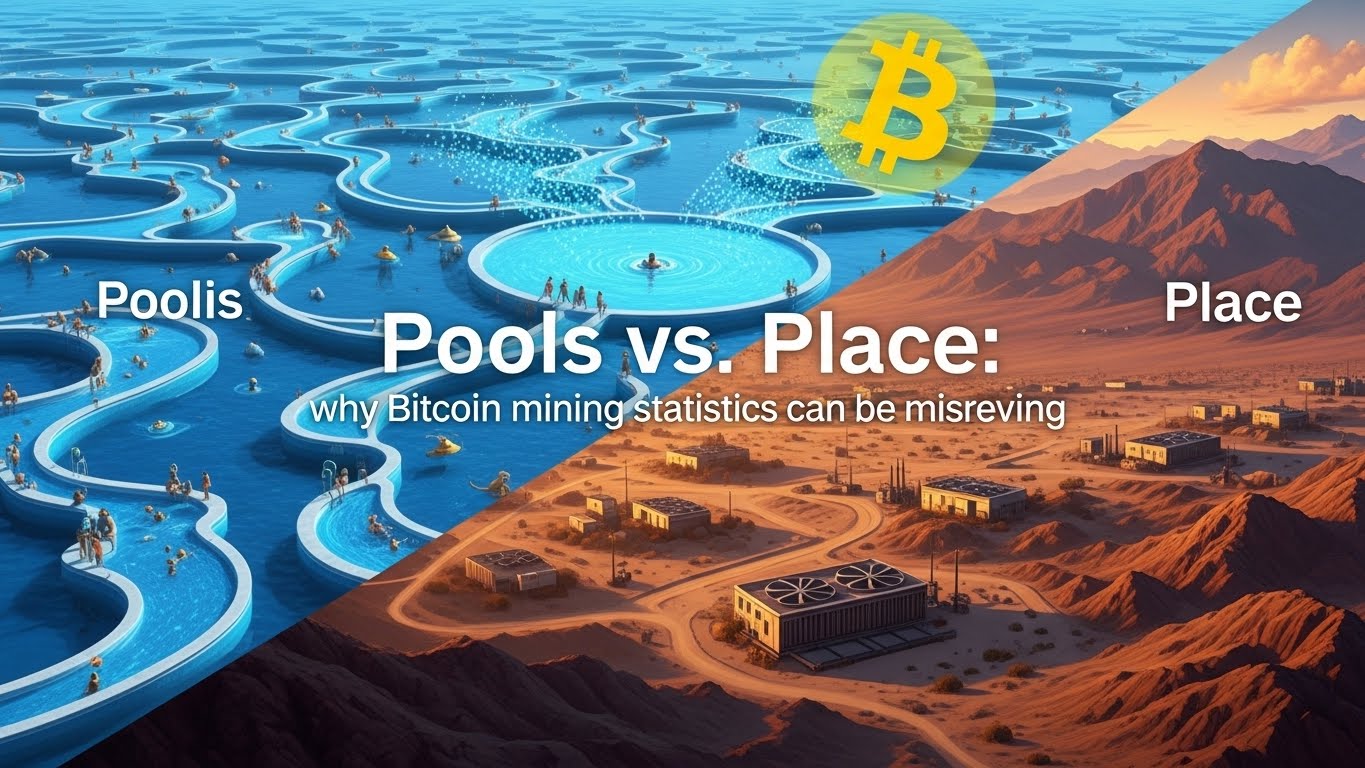
This matters because political ambition often targets physical reality—jobs, grid load, industrial sites—while crypto narratives often track pool data because it’s visible on-chain. You can have a world where U.S.-linked pools look dominant while the physical machines powering those blocks are increasingly international. That’s one pathway through which America’s “grip” on Bitcoin mining can appear to slip even if U.S. institutions remain influential.
The post-halving squeeze: efficiency becomes the new form of dominance
The 2024 halving changed the economics of Bitcoin mining by cutting the block subsidy. That pushed the industry toward relentless efficiency. Miners with older machines, expensive power, or higher overhead were forced to shut down, consolidate, or relocate. Those with access to cheaper energy and next-generation ASICs gained share.
In the U.S., large public miners often have advantages—capital access, professionalized operations, and scale. Yet scale can also bring exposure to public-market pressure and higher transparency demands. In other regions, privately financed operators can sometimes move faster, accept different risk profiles, or structure power deals less visible to the public.
This is why the “dominance” conversation is shifting from simple geography to operational edge. In 2026, dominance in Bitcoin mining increasingly means best-in-class uptime, lowest all-in power costs, smart hedging, and the ability to survive revenue shocks without dumping reserves at the worst time.
The North American advantage that still matters in Bitcoin mining
Even with a slipping share, the U.S. remains structurally important to Bitcoin mining. America has deep capital markets, an ecosystem of audited public miners, and a sophisticated set of energy and financial tools that help miners manage volatility. TheMinerMag and other industry trackers have documented large and growing power capacity among public miners operating across the U.S. and Canada, illustrating that North America remains a heavyweight in industrial Bitcoin mining infrastructure.
There’s also a credibility factor. Institutional investors often prefer exposure to regulated entities with transparent reporting. That doesn’t automatically translate to higher global hashrate share, but it can translate into influence over industry standards, treasury strategies, and long-term business models.So the story isn’t that America is losing relevance. The story is that U.S. influence must now compete with a broader international expansion wave, and the U.S. must protect its cost structure if it wants to retain a commanding slice of Bitcoin mining.
What would it take for the U.S. to regain Bitcoin mining dominance?
If the U.S. wants to push back against a slipping grip in Bitcoin mining, the path is less about speeches and more about infrastructure and policy clarity.First, miners need abundant, predictable power. That means faster interconnections, expansion of transmission where needed, and market designs that reward flexible loads without turning miners into political scapegoats during grid stress.Second, the U.S. needs a realistic hardware strategy. Domestic manufacturing of ASICs is a long-term project, not a switch. Policies that abruptly increase hardware costs can weaken U.S. miners in the short term, even if the long-term goal is supply-chain resilience.
Third, regulatory clarity matters more than permissiveness. Miners can operate under rules if the rules are stable. Uncertainty—whether from changing reporting requirements, potential taxation proposals, or local moratorium threats—raises the risk premium and drives expansion abroad.Finally, the industry needs social license. Bitcoin mining that demonstrably supports grid stability, uses curtailed renewables, or monetizes stranded energy has a better chance of enduring politically than mining that feels extractive to local communities.Trump’s ambition—“made in the USA”—collides with these realities. It may influence tone and enforcement priorities, but it cannot substitute for the slow, expensive work of building the next era of American industrial power.
Conclusion
America’s grip on Bitcoin mining is slipping not because the U.S. suddenly became irrelevant, but because the global market is adapting faster than a single country can lock down. Energy economics, supply-chain chokepoints, post-halving efficiency pressure, and local regulatory battles all shape where Bitcoin mining grows next. Trump’s ambitions for dominance capture a political mood, but the industry’s center of gravity follows hashrate incentives—cheap power, reliable infrastructure, and predictable rules—more than patriotic messaging.
The United States can still remain a major pillar of Bitcoin mining, and perhaps even expand its absolute footprint. But holding or regaining a dominant share will require competitiveness at the margin: better power deals, smoother permitting, resilient grids, and a sober plan for hardware dependence. In Bitcoin mining, leadership is never declared. It’s continuously proven, block by block.
FAQs
Q: Is the U.S. still the top country for Bitcoin mining?
The U.S. remains one of the most important hubs for Bitcoin mining, with large-scale industrial operators and major pool influence, but the global share can fluctuate as other regions expand and add cheaper energy capacity.
Q: Why does Bitcoin mining move between countries so often?
Because Bitcoin mining is highly sensitive to electricity pricing, regulation, and access to modern ASIC hardware. When a region offers meaningfully cheaper or more stable power, miners can redeploy capital quickly, making the global hashrate map dynamic.
Q: How did Trump influence the Bitcoin mining conversation?
Trump publicly pushed the idea that remaining bitcoin should be “made in the USA,” tying Bitcoin mining to energy dominance and national competitiveness. That messaging can shape industry expectations, but practical outcomes still depend on power, infrastructure, and regulation.
Q: Does the 2024 halving still affect Bitcoin mining in 2026?
Yes. The halving reduced mining rewards, accelerating a shift toward efficiency. In 2026, Bitcoin mining profitability is still heavily influenced by who has the lowest power costs, the newest machines, and the strongest operational uptime.
Q: Are mining pools the same thing as where Bitcoin mining happens?
Not exactly. Mining pools coordinate block production and can appear dominant even when machines are distributed globally. Pool data is visible and often U.S.-heavy in certain periods, but physical location of machines can be more internationally spread.
Also More: New Bitcoin Mining: Fleet Mining Reshapes the Future of Miners, Sign Up and Get $100