Crypto Firms Raise $258M Amid $2T Market Drawdown
Crypto firms raise $258m despite a $2 trillion market drawdown, signaling investor confidence, long-term adoption, and resilient blockchain innovation.


The global cryptocurrency market has endured one of its most severe contractions in recent history, with more than $2 trillion wiped off total market capitalization from peak levels. Prices of major digital assets have fallen sharply, retail participation has cooled, and headlines frequently highlight bankruptcies, regulatory crackdowns, and declining trading volumes. Against this backdrop of pessimism, one data point stands out as both surprising and instructive: crypto firms raise $258m despite $2 trillion market drawdown.
This capital influx challenges the narrative that investor confidence in crypto has collapsed. Instead, it reveals a more nuanced reality. While speculative excess has been purged, venture capital, private equity, and strategic investors continue to deploy funds into select crypto startups they believe will define the next phase of the industry. These investments are not blind bets on price appreciation but targeted commitments to infrastructure, compliance-ready platforms, blockchain scalability, Web3 applications, and real-world utility.
Understanding why crypto firms are still raising capital during a historic downturn requires examining where the money is going, who is investing, and what this signals about the long-term trajectory of the digital asset ecosystem. This article explores how crypto fundraising resilience, investor strategy, and technological fundamentals intersect, even as markets remain under pressure.
The Scale of the Crypto Market Drawdown
Understanding the $2 Trillion Contraction
The crypto market drawdown reflects a combination of macroeconomic tightening, reduced risk appetite, and structural weaknesses exposed during the previous bull cycle. Rising interest rates globally reduced liquidity, pushing investors away from speculative assets. At the same time, the collapse of overleveraged entities accelerated forced liquidations, compounding losses.
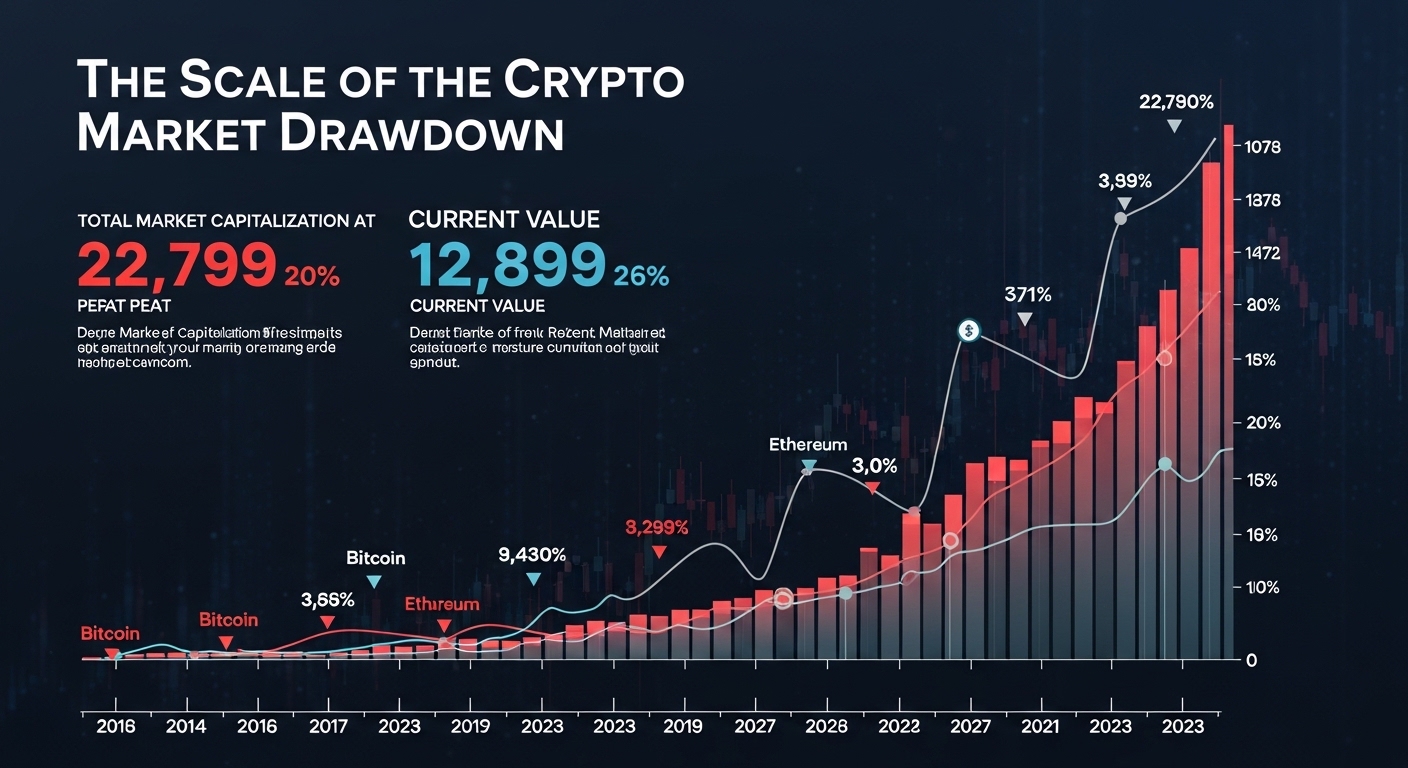
Despite this dramatic contraction, blockchain networks continue to operate uninterrupted. Transactions settle, developers ship updates, and users engage with decentralized applications. This operational continuity helps explain why crypto firms raise $258m despite $2 trillion market drawdown, as investors differentiate between token prices and underlying technology.
Bear Markets as Industry Filters
Historically, crypto bear markets function as filters rather than endings. Weak projects disappear, but robust ones refine their models. Investors with long horizons often see downturns as optimal entry points. Lower valuations allow capital to be deployed more efficiently, while reduced hype improves signal quality.This dynamic is central to why crypto venture funding persists. Investors are no longer chasing meme-driven growth but backing firms focused on sustainability, compliance, and enterprise adoption.
Why Crypto Firms Raise $258m Despite $2 Trillion Market Drawdown
Long-Term Conviction Over Short-Term Price Action
One of the clearest explanations is that institutional investors increasingly view crypto as a long-term infrastructure play. Blockchain technology, digital asset custody, tokenization, and decentralized finance solve structural problems in payments, settlement, and data ownership. These use cases do not disappear during price downturns.The fact that crypto firms raise $258m despite $2 trillion market drawdown reflects confidence that the current cycle mirrors previous downturns where innovation quietly accelerated beneath the surface.
Selective Capital Allocation
Unlike the exuberant funding environment of bull markets, current capital deployment is highly selective. Investors scrutinize revenue models, regulatory positioning, and technical differentiation. This discipline improves overall capital efficiency and strengthens surviving firms.
Startups raising funds today often demonstrate clear product-market fit or serve as foundational infrastructure providers. This includes custody platforms, blockchain analytics firms, layer-2 scaling solutions, and enterprise-grade compliance tools.
Where the $258 Million Is Going
Infrastructure and Core Blockchain Services
A significant portion of the $258 million raised by crypto firms flows into blockchain infrastructure. These companies build the plumbing that enables applications, exchanges, and institutions to operate securely and at scale. Examples include node providers, interoperability protocols, and data indexing services.
Infrastructure investments tend to be countercyclical because demand for reliable systems grows as the industry matures. Even during downturns, developers need stable environments to build, test, and deploy decentralized applications.
Compliance, Security, and Risk Management
Another major funding destination is compliance and security. As regulators intensify oversight, crypto firms require advanced AML, KYC, and risk-monitoring tools. Startups offering blockchain analytics, transaction monitoring, and fraud detection have become increasingly attractive to investors.This trend reinforces why crypto firms raise $258m despite $2 trillion market drawdown, as regulatory clarity, while challenging, also creates demand for specialized solutions that traditional finance lacks.
Web3, Gaming, and Digital Ownership
Although speculative NFT markets cooled, underlying Web3 concepts remain compelling. Investors continue to back gaming platforms, creator economies, and decentralized identity projects that leverage blockchain for digital ownership and user-controlled data.These investments signal belief that consumer-facing crypto applications will re-emerge stronger, supported by better user experience and sustainable monetization.
Investor Profiles Driving Crypto Fundraising
Venture Capital and Strategic Funds
The majority of funding comes from venture capital firms specializing in fintech, crypto, and deep technology. These investors often have decade-long horizons and understand that transformational technologies develop unevenly.
Strategic investors, including traditional financial institutions and technology companies, also play a role. Their participation suggests that crypto infrastructure is increasingly viewed as complementary to existing systems rather than disruptive in a destructive sense.
Institutional Investors and Family Offices
Family offices and institutional allocators are becoming more prominent in private crypto funding rounds. Their capital is typically patient and less sensitive to short-term volatility, aligning well with infrastructure-focused startups.This shift in investor composition further explains why crypto firms raise $258m despite $2 trillion market drawdown, as capital sources are maturing alongside the industry.
Valuations Reset but Opportunity Expands
Healthier Pricing for Long-Term Growth
The drawdown has reset valuations to more realistic levels. While painful for founders and early investors, this correction creates healthier entry points. Capital raised today often comes with expectations of disciplined growth rather than rapid, unsustainable expansion.Lower valuations also reduce pressure to issue tokens prematurely, allowing startups to focus on product development before market exposure.
Talent Consolidation During the Downturn
Bear markets push talent toward high-quality projects. Engineers, researchers, and operators displaced from failed ventures often join better-capitalized firms. This concentration of talent accelerates innovation and execution, increasing the likelihood of long-term success.
Macroeconomic Context and Crypto Resilience
Interest Rates, Inflation, and Risk Assets

Global monetary tightening reduced liquidity across all risk assets, not just crypto. Technology stocks, venture funding, and private equity valuations also declined. Within this broader context, crypto’s ability to attract $258 million appears less anomalous and more reflective of selective confidence.As macro conditions stabilize, projects funded during downturns often emerge as category leaders.
Decoupling Narrative and Reality
While public discourse often frames crypto as collapsing, funding data reveals ongoing belief in its structural relevance. This disconnect highlights the importance of distinguishing between market sentiment and fundamental progress.The fact that crypto firms raise $258m despite $2 trillion market drawdown underscores that innovation does not pause simply because prices fall.
Regulatory Pressure as a Catalyst for Investment
Clarity Creates Opportunity
Although regulatory scrutiny initially deterred some investors, clearer rules ultimately reduce uncertainty. Startups building compliant platforms benefit from regulatory engagement, gaining credibility with institutions.Investors recognize that firms capable of navigating regulation will command significant market share once compliance becomes non-negotiable.
Jurisdictional Competition
Different regions compete to attract crypto innovation through regulatory frameworks. This competition incentivizes governments to refine policies, indirectly supporting startups that align with legal standards.
Comparing This Cycle to Previous Bear Markets
Lessons From 2018 and 2020
Past downturns show similar patterns. After the 2018 crash, funding slowed but did not stop. Companies founded or refined during that period later became industry leaders.The current cycle appears to follow this trajectory, with crypto firms raising capital while quietly building the next generation of products.
Structural Maturity of the Industry
Unlike earlier cycles, today’s crypto ecosystem includes institutional custody, derivatives markets, and enterprise integrations. This maturity reduces existential risk and supports sustained investment, even during downturns.
The Strategic Importance of Timing
Building During the Quiet Phase
Startups raising funds now benefit from reduced noise. Marketing costs decline, user acquisition becomes more organic, and partnerships form based on substance rather than hype.Investors understand that products built during downturns often align better with real-world needs.
Preparing for the Next Growth Phase
Capital raised today positions firms to scale when market conditions improve. Infrastructure built now supports future demand, reinforcing why crypto firms raise $258m despite $2 trillion market drawdown is a signal of forward-looking strategy.
Long-Term Implications for the Crypto Industry
Shift From Speculation to Utility
The funding pattern indicates a gradual shift from speculative trading toward practical applications. Payments, settlement, identity, and data integrity use cases dominate investment theses.This evolution enhances crypto’s credibility among enterprises and policymakers.
Stronger Foundations for Adoption
With capital directed toward infrastructure and compliance, the industry’s foundation strengthens. When retail interest returns, it will encounter more robust, user-friendly systems.
Conclusion
The headline that crypto firms raise $258m despite $2 trillion market drawdown encapsulates a critical truth about the digital asset industry. While prices fluctuate and sentiment swings, the underlying innovation engine continues to run. Investors are not abandoning crypto; they are refining their focus.
This period represents a recalibration rather than a collapse. Capital is flowing to projects that prioritize sustainability, regulation, and real-world utility. As history suggests, the firms built during downturns often define the next era of growth. In that sense, today’s $258 million may prove far more influential than billions invested during speculative peaks.
FAQs
Q: Why are crypto firms still raising money during a market downturn?
Crypto firms raise capital during downturns because investors focus on long-term technology value rather than short-term price movements. Lower valuations and clearer use cases make this an attractive period for strategic investment.
Q: What types of crypto companies attracted the $258 million in funding?
Most funding went to infrastructure providers, compliance and security firms, and Web3 platforms focused on sustainable applications rather than speculation.
Q: Does this fundraising mean the crypto bear market is over?
Not necessarily. Fundraising activity indicates confidence in long-term prospects, but market recovery depends on broader economic and liquidity conditions.
Q: How does this funding compare to previous crypto cycles?
Compared to earlier cycles, current funding is more selective and focused on fundamentals, reflecting a maturing industry with institutional participation.
Q: What does this mean for the future of crypto adoption?
It suggests that adoption will be driven by robust infrastructure, regulatory alignment, and real-world utility, creating a stronger foundation for future growth.