Bitcoin Miners Top 1 Zettahash as Profits Shrink
Bitcoin miners surpass 1 zettahash in network power, but shrinking margins and rising difficulty push mining profits near historic lows.

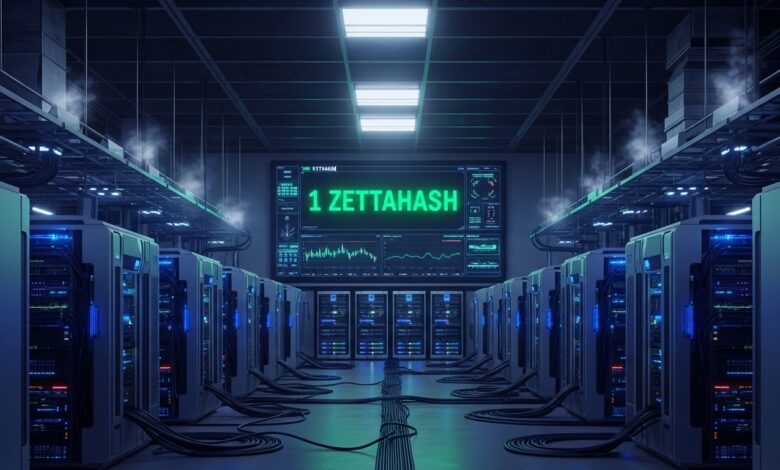
The global Bitcoin mining industry has reached a historic milestone as the network’s total computational power surged beyond 1 zettahash per second. This achievement marks one of the most significant moments in the evolution of Bitcoin, reinforcing its status as the most secure and decentralized blockchain in operation today. However, while the network’s hash rate has never been stronger, the financial reality for Bitcoin miners tells a very different story.
Despite crossing the 1 zettahash threshold, mining profits remain near historic lows. The contrast between record-breaking computational power and compressed profitability reflects a deeper transformation within the crypto mining ecosystem. Rising network difficulty, post-halving Bitcoin Miners Top 1 Zettahash reward reductions, capital-intensive infrastructure expansion, and volatile energy markets have created a fiercely competitive environment where only the most efficient operators can sustain margins.This article explores the significance of surpassing 1 zettahash, the economic pressures facing Bitcoin miners, the structural evolution of the mining sector, and what lies ahead for the broader digital asset infrastructure market.
The Meaning of 1 Zettahash in Bitcoin Mining
Reaching 1 zettahash per second represents a trillion gigahashes of computing power securing the Bitcoin blockchain. In practical terms, this means the network now performs sextillions of cryptographic calculations every second to validate transactions and maintain consensus.
Hash Rate as a Security Benchmark
The hash rate functions as a proxy for network security. A higher hash rate makes a 51% attack economically and technically infeasible, thereby strengthening Bitcoin’s resilience against malicious actors. Crossing 1 zettahash signals extraordinary levels of global miner participation and infrastructure investment.
However, hash rate growth does not automatically translate into higher profits. Instead, it increases competition. As more computational power enters the network, individual miners must contribute proportionally more hash power to maintain the same probability of earning block rewards.
Historical Growth and Industrial Expansion
Bitcoin mining has evolved from small-scale operations using CPUs and GPUs into industrial-scale data centers powered by advanced ASIC hardware. Major manufacturers such as Bitmain and MicroBT have consistently improved machine efficiency, reducing energy consumption per terahash.
The surge past 1 zettahash reflects both technological progress and institutional participation. Large publicly traded mining companies have expanded aggressively, deploying thousands of high-efficiency machines across multiple jurisdictions. This industrialization has increased network strength but simultaneously compressed margins due to heightened competition.
Why Mining Profits Are Near Historic Lows
The paradox of record hash rate and weak profitability is rooted in fundamental economic forces within the Bitcoin protocol.
Post-Halving Revenue Compression
Bitcoin’s supply issuance follows a fixed schedule. Approximately every four years, the block subsidy is reduced by half. This halving mechanism ensures scarcity but directly reduces miner revenue in BTC terms. After the most recent halving event, miners saw their base reward per block cut by 50 percent overnight.
Unless the Bitcoin price doubles to compensate, overall revenue declines. While transaction fees provide supplemental income, they fluctuate with network activity and cannot consistently offset the reduced subsidy. As a result, mining revenue per terahash has declined significantly.
Rising Network Difficulty
Bitcoin’s difficulty adjustment algorithm recalibrates every 2,016 blocks to maintain a ten-minute block interval. As hash rate rises above 1 zettahash, difficulty increases proportionally. This means miners must expend more computational effort to solve blocks.Higher difficulty directly reduces earnings per unit of hash power. Even though the network appears stronger than ever, individual miners experience shrinking profit margins as operational costs remain elevated.
The Economics of Modern Bitcoin Mining
Energy as the Primary Cost Driver
Electricity remains the dominant operational expense in Bitcoin mining. The cost per kilowatt-hour often determines whether a mining operation is profitable or unprofitable. Miners actively seek regions with abundant renewable energy, stranded natural gas, or surplus grid capacity.
In today’s environment, hashprice, which measures daily revenue per terahash, has dropped to levels that challenge even well-capitalized operators. When hashprice declines while energy prices remain elevated, margins compress dramatically.Efficient energy procurement strategies, long-term power purchase agreements, and grid stabilization partnerships have become essential components of mining business models.
Hardware Efficiency and Capital Intensity
Advanced ASIC miners offer significantly improved energy efficiency compared to older generations. Operators deploying the latest machines can lower their cost per Bitcoin mined. However, upgrading fleets requires substantial capital expenditure.
Many publicly traded mining companies finance expansion through equity issuance or debt. This increases financial leverage and introduces balance sheet risk, particularly during prolonged periods of weak profitability. As competition intensifies, outdated hardware becomes obsolete quickly, accelerating the need for continual reinvestment.
Institutionalization and Market Structure

The crossing of 1 zettahash reflects growing institutional participation in Bitcoin mining. Industrial-scale facilities now dominate global hash power distribution.
Public Mining Companies and Consolidation
Large mining firms operate across multiple continents, securing energy contracts and scaling operations to maximize efficiency. These companies benefit from economies of scale, optimized cooling systems, and strategic site selection.
However, smaller independent miners face mounting pressure. As margins shrink, consolidation becomes inevitable. Stronger players absorb weaker competitors, increasing concentration within the sector while maintaining overall network growth.
Mining Pools and Decentralization
Most miners participate in mining pools to stabilize revenue streams. Pools aggregate hash power and distribute rewards proportionally. While this reduces income volatility, it also raises concerns regarding centralization.Maintaining decentralized distribution of hash power is critical for Bitcoin’s long-term integrity. The milestone of 1 zettahash underscores strength but also necessitates vigilance regarding concentration risks.
Transaction Fees and the Security Budget
As block subsidies decline over time, transaction fees will play an increasingly important role in miner revenue.
Fee Market Volatility
During periods of heightened on-chain activity, transaction fees can surge, temporarily boosting mining profitability. However, fee markets are cyclical and tied to network usage patterns.If Bitcoin adoption continues to expand globally, sustained fee growth may partially offset future subsidy reductions. Until then, miners remain dependent primarily on block rewards and price appreciation.
Geographic Shifts in Global Mining
Bitcoin mining is highly mobile. Regulatory shifts, energy costs, and geopolitical conditions influence where hash power is deployed.Countries offering stable regulatory frameworks and affordable energy attract substantial mining investment. Conversely, restrictive policies can prompt rapid relocation of mining infrastructure.The dispersion of hash power across multiple regions enhances network resilience, even as profitability remains compressed.
Environmental Considerations and Energy Innovation
Environmental debates surrounding Bitcoin mining persist. However, the industry increasingly integrates renewable and low-carbon energy sources.Mining operations often utilize hydroelectric, wind, solar, and even flared gas resources that would otherwise go unused. This dynamic has repositioned Bitcoin mining as a potential grid stabilizer and energy buyer of last resort.Crossing 1 zettahash demonstrates not only scale but also innovation in energy sourcing and infrastructure design.
Bitcoin Price Correlation and Market Sentiment
Mining profitability remains highly correlated with Bitcoin’s market price. A sustained bull market can rapidly restore margins, even in high-difficulty environments.When hash rate rises despite low profits, it signals long-term conviction among miners. Operators are effectively positioning for future price appreciation, investing in infrastructure ahead of potential market expansion.Conversely, if Bitcoin price stagnates, prolonged margin compression may trigger miner capitulation events.
The Competitive Shakeout Ahead
Low profitability environments historically lead to operational shakeouts. Inefficient miners power down equipment, reducing overall hash rate temporarily.However, surpassing 1 zettahash suggests resilience rather than retreat. Stronger operators continue expanding, confident in Bitcoin’s long-term trajectory.This phase may represent a transitional period where industrial efficiency determines survival. Those with access to low-cost energy, cutting-edge hardware, and prudent financial management are positioned to endure.
Conclusion
Bitcoin miners powering back above 1 zettahash marks a defining milestone in the history of Bitcoin mining. It confirms unprecedented network security, global participation, and industrial maturity. Yet, beneath the surface, profitability remains under intense pressure.
Rising difficulty, post-halving reward reductions, elevated capital costs, and competitive expansion have pushed mining profits near historic lows. The industry now operates on razor-thin margins, rewarding only the most efficient and strategically positioned players.
Ultimately, the sustainability of Bitcoin mining hinges on a combination of technological innovation, energy optimization, and Bitcoin price appreciation. The 1 zettahash era reflects confidence and resilience, but the path forward will test operational discipline across the entire mining ecosystem.
FAQs
Q: What does 1 zettahash mean for Bitcoin?
It represents one sextillion hash calculations per second securing the network, significantly strengthening Bitcoin’s resistance to attacks.
Q: Why are Bitcoin mining profits so low right now?
Profits are compressed due to higher network difficulty, reduced block rewards after halving, and elevated energy and hardware costs.
Q: What is hashprice in Bitcoin mining?
Hashprice measures the daily revenue generated per terahash of computing power, serving as a key profitability metric.
Q: Can mining profitability recover in the future?
Yes, if Bitcoin’s market price rises substantially or transaction fee revenue increases, profitability can improve even at high difficulty levels.
Q: Does higher hash rate always mean stronger Bitcoin?
Generally, yes. A higher hash rate enhances network security and reflects miner confidence, although it does not guarantee higher profits for individual operators.
Also More: Bitcoin Slides to $60K Why Crypto Is Getting “Trumped”