38% of Altcoins Near All-Time Lows as BTC.D Rises
38% of altcoins hover near all-time lows as BTC.D climbs. Is this the bullish setup crypto investors have been waiting for?


The cryptocurrency market is once again at a pivotal inflection point. Recent data indicates that nearly 38% of altcoins are trading close to their all-time lows, while Bitcoin dominance (BTC.D) continues to trend upward. This dynamic has sparked intense debate across trading desks, crypto forums, and institutional research reports. Is this capitulation phase the final washout before a powerful altcoin rebound? Or does rising BTC.D signal prolonged weakness in the broader digital asset market?
To understand whether this is truly the setup 38% of Altcoins Near All-Time bulls need, investors must examine the structural relationship between Bitcoin dominance, altcoin market cycles, liquidity conditions, and historical price behavior. The interplay between Bitcoin and altcoins has historically defined market regimes, shaping both risk appetite and capital allocation strategies.
As BTC.D climbs, capital consolidates into Bitcoin, often draining liquidity from smaller-cap tokens. Meanwhile, altcoins near all-time lows frequently signal deep undervaluation, forced selling, and market exhaustion. When these two forces converge, the crypto ecosystem can enter a compressed volatility phase—one that sometimes precedes explosive trend reversals.This article explores what it means that 38% of altcoins are near all-time lows as BTC.D climbs, whether historical precedents support a bullish case, and how traders and investors should interpret this market structure.
Understanding Bitcoin Dominance (BTC.D) and Its Market Impact
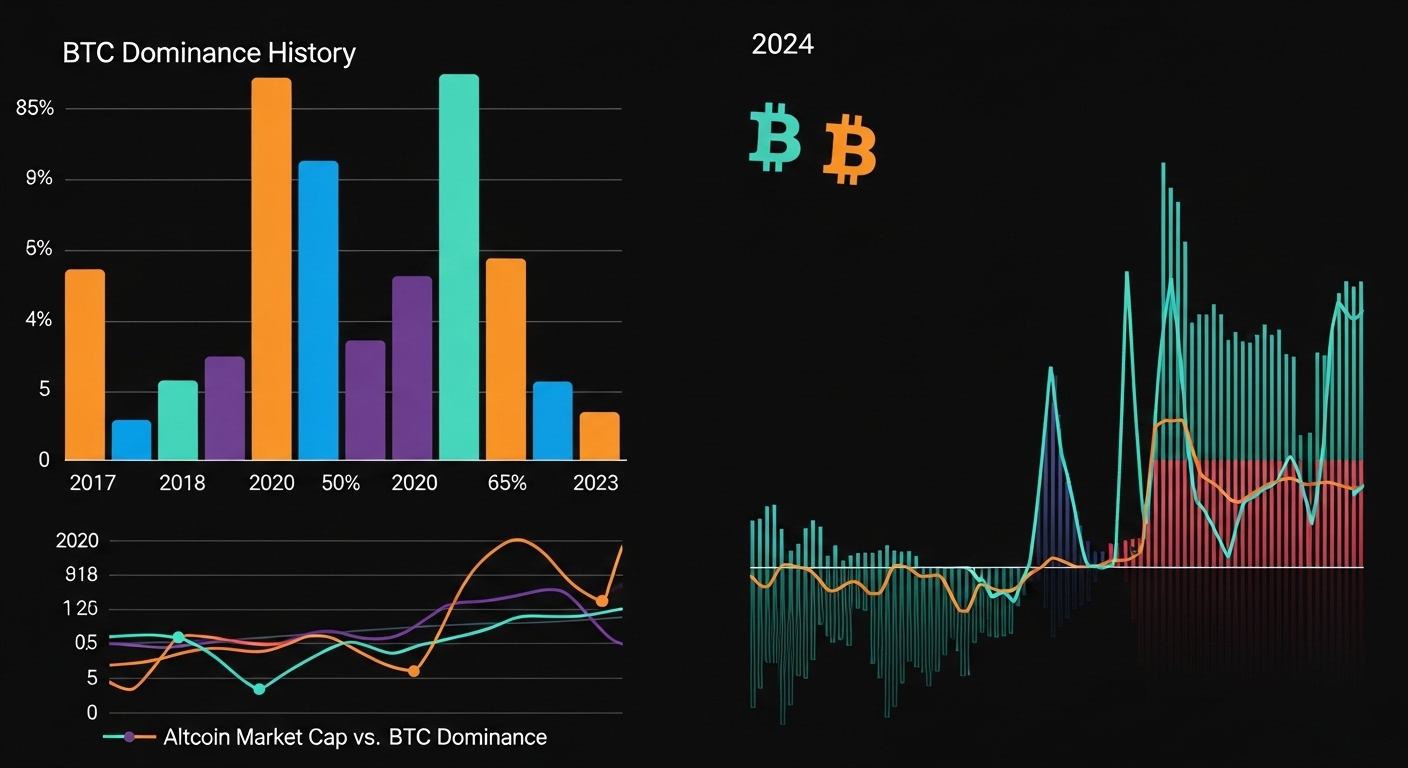
Bitcoin dominance, often abbreviated as BTC.D, represents Bitcoin’s share of the total cryptocurrency market capitalization. When BTC.D rises, Bitcoin captures a larger percentage of total market value relative to altcoins. When it falls, altcoins gain market share and typically outperform.
What Drives Bitcoin Dominance Higher?
Several macro and micro factors can cause BTC.D to increase. During periods of uncertainty, investors often rotate capital into Bitcoin because it is perceived as the most secure and liquid crypto asset. Bitcoin has deeper order books, stronger institutional participation, and greater regulatory clarity compared to most altcoins.
A rising BTC.D also occurs during early bull cycles when Bitcoin leads the market upward before capital trickles down into mid-cap and small-cap tokens. Conversely, in bear markets, BTC.D climbs because altcoins tend to decline more aggressively than Bitcoin.When 38% of altcoins are near all-time lows as BTC.D climbs, it typically signals one of two scenarios: either an extended risk-off environment or a late-stage bear market capitulation phase.
Why 38% of Altcoins Near All-Time Lows Matters
When a significant portion of the altcoin market trades close to historical bottoms, it reflects widespread selling pressure, weak sentiment, and reduced liquidity. However, from a cyclical standpoint, such conditions can also create asymmetrical risk-reward setups.
Market Capitulation and Exhaustion
In traditional financial markets, broad-based asset declines often precede major reversals. Crypto markets operate similarly but with amplified volatility. When nearly 40% of altcoins are near all-time lows, it suggests deep capitulation. Retail participants have largely exited, venture-backed tokens have deflated, and speculative excess has been purged.
Historically, these periods have preceded powerful altcoin rallies, particularly when Bitcoin stabilizes and BTC.D peaks. The logic is straightforward: once Bitcoin’s upward dominance trend slows, sidelined capital begins searching for higher beta opportunities, often flowing back into undervalued altcoins.
Historical Patterns: When BTC.D Climbs Before Altcoin Seasons
Examining past cycles provides important context. During previous bull markets, Bitcoin dominance often surged before a rotation into altcoins. This pattern was evident in the 2016–2017 cycle and again during the 2020–2021 expansion.
Early Cycle Leadership by Bitcoin
In early bull phases, Bitcoin attracts institutional capital, macro investors, and ETF-driven flows. Its relative safety and brand recognition make it the primary beneficiary of fresh liquidity. As a result, BTC.D climbs while altcoins lag behind.Once Bitcoin establishes a strong base and volatility compresses, traders seek higher returns in smaller-cap assets. That rotation phase, often called “altseason,” typically coincides with declining BTC.D.
The current scenario—38% of altcoins near all-time lows as BTC.D climbs—resembles late-stage accumulation zones observed before previous altcoin rallies. However, timing remains uncertain and heavily dependent on broader liquidity conditions.
Liquidity, Macro Conditions, and Crypto Market Structure
Cryptocurrency markets do not operate in isolation. Global liquidity cycles, central bank policy, and macroeconomic trends influence capital flows into digital assets.
The Role of Global Liquidity
When monetary conditions tighten, risk assets suffer. Altcoins, being high-beta instruments, often experience sharper drawdowns than Bitcoin. This dynamic accelerates BTC.D’s rise. Conversely, when liquidity expands, speculative capital re-enters the market, often benefiting altcoins disproportionately.

If global liquidity improves while 38% of altcoins are near all-time lows, the setup could become structurally bullish. Deeply discounted tokens combined with expanding capital availability historically create strong recovery environments.
Technical Indicators Supporting a Potential Reversal
Beyond macro narratives, technical analysis offers additional clues about whether this environment favors bulls.
Oversold Conditions Across Altcoin Indexes
Relative Strength Index (RSI) readings across many altcoins have entered oversold territory. Long-term support zones, measured from previous cycle lows, are being tested. Such conditions often precede relief rallies.Meanwhile, BTC.D approaching multi-year resistance levels could indicate dominance exhaustion. If Bitcoin dominance begins forming a top while altcoins remain compressed near all-time lows, traders may interpret it as a rotation trigger.
Market Breadth and Divergences
Another key metric is market breadth. When a small number of large-cap tokens hold up while the majority collapse, it suggests internal weakness. However, if breadth stabilizes and selling pressure diminishes despite bearish headlines, it can signal accumulation beneath the surface.
Psychological Dynamics: Fear, Fatigue, and Opportunity
Crypto markets are heavily sentiment-driven. When 38% of altcoins are near all-time lows, morale across the ecosystem is typically depressed. Social engagement declines, retail participation falls, and narratives turn defensive.
Paradoxically, these environments often present long-term opportunities. Fear-driven liquidations tend to mark late-cycle exhaustion phases. Investors with longer time horizons view extreme pessimism as a contrarian indicator.As BTC.D climbs, Bitcoin’s relative strength can restore overall market confidence. Once Bitcoin stabilizes and upward volatility cools, risk appetite may gradually return to altcoins.
Are All Altcoins Equally Positioned for Recovery?
It is crucial to distinguish between fundamentally strong projects and structurally weak tokens. Not every altcoin near all-time lows will recover.
Fundamental Strength vs. Speculative Excess
Projects with active developer ecosystems, real user adoption, and sustainable tokenomics are more likely to rebound. Tokens driven purely by speculative hype without utility often struggle to regain prior highs.During previous cycles, leading smart contract platforms, DeFi protocols, and layer-2 scaling solutions rebounded aggressively once conditions improved. Meanwhile, weaker projects faded into irrelevance.Therefore, the fact that 38% of altcoins are near all-time lows does not automatically imply universal opportunity. Selectivity remains critical.
Bitcoin Dominance as a Timing Tool
Traders often use BTC.D as a timing mechanism for altcoin exposure. When dominance peaks and begins trending downward, it frequently marks the start of altcoin outperformance.If BTC.D continues climbing without signs of reversal, altcoins may remain under pressure. However, if dominance stalls near historical resistance, it could signal rotation potential.Understanding this relationship helps investors manage risk and avoid premature entries.
Institutional Participation and Market Evolution
The crypto market has matured significantly compared to prior cycles. Institutional participation, regulated investment vehicles, and corporate treasury adoption have strengthened Bitcoin’s position.This structural evolution may mean that BTC.D behaves differently than in previous cycles. Bitcoin could maintain elevated dominance for longer periods, compressing altcoin performance windows.Nonetheless, cyclical rotation patterns have not disappeared entirely. Market psychology and capital efficiency continue to drive shifts between Bitcoin and altcoins.
Risks That Could Invalidate the Bullish Setup
While 38% of altcoins near all-time lows as BTC.D climbs may resemble a bullish setup, several risks remain.Prolonged macro tightening, regulatory crackdowns, or systemic crypto failures could sustain dominance trends and suppress altcoin recoveries. Additionally, declining venture capital inflows into blockchain projects could limit innovation-driven momentum.If Bitcoin experiences a sharp correction while BTC.D remains high, altcoins could face another leg down before stabilization.
Strategic Approaches for Investors
Given the current landscape, investors may consider a phased approach. Gradual accumulation in fundamentally strong projects while monitoring BTC.D resistance zones can help manage risk.Portfolio diversification, disciplined position sizing, and awareness of macro liquidity trends are essential. Rather than attempting to time exact bottoms, focusing on structural conditions and capital preservation may yield better outcomes.Long-term investors often view periods when 38% of altcoins are near all-time lows as accumulation zones rather than panic signals.
Conclusion
The reality that 38% of altcoins are near all-time lows as BTC.D climbs presents a complex but potentially compelling market setup. Rising Bitcoin dominance reflects capital consolidation and risk aversion, while widespread altcoin weakness signals deep capitulation.Historically, similar conditions have preceded powerful altcoin recoveries—particularly when Bitcoin stabilizes and dominance peaks. However, market timing remains uncertain and dependent on macro liquidity, investor sentiment, and structural developments within the crypto ecosystem.
For disciplined investors, this phase may represent a strategic inflection point rather than a reason for despair. If Bitcoin dominance approaches resistance and liquidity conditions improve, the groundwork for a new altcoin cycle could emerge.Whether this is truly the setup bulls need will depend not just on charts, but on patience, risk management, and careful project selection.
FAQs
Q: What does it mean when 38% of altcoins are near all-time lows?
It indicates widespread weakness across the altcoin market, often associated with capitulation, low liquidity, and bearish sentiment. Historically, such conditions can precede recovery phases.
Q: Why does Bitcoin dominance (BTC.D) matter?
BTC.D measures Bitcoin’s share of total crypto market capitalization. Rising dominance often signals capital flowing into Bitcoin and away from altcoins.
Q: Does a rising BTC.D always hurt altcoins?
Generally, yes. However, once BTC.D peaks and reverses, altcoins often experience strong outperformance.
Q: Is this a good time to buy altcoins?
It depends on risk tolerance, time horizon, and project fundamentals. Deeply oversold conditions can present opportunities but carry volatility risks.
Q: What should investors watch next?
Key indicators include BTC.D resistance levels, Bitcoin price stability, global liquidity trends, and improving market breadth across altcoins.
Also More: 3 Altcoins to Watch in February 2026 Market Shift