Bitcoin Sentiment Shattered as Altcoins Rebound
Bitcoin sentiment is cooling while select altcoin pockets rebound. Discover what’s driving the shift, key risks, and how traders can adapt.


For years, crypto investors have repeated one mantra: when Bitcoin moves, the rest of the market follows. But the latest market structure is breaking that pattern. Bitcoin Sentiment Shattered. Bitcoin sentiment has cooled sharply, with traders growing cautious after periods of intense volatility, failed breakouts, and macro uncertainty. At the same time, altcoin pockets are quietly rebounding, drawing capital and attention toward smaller, higher-beta plays that seem to be waking up while the king of crypto stalls.
This divergence is forcing investors to rethink familiar assumptions. If Bitcoin sentiment is shattered in the short term, why are some altcoins rallying? Is this the start of a sustained altcoin rotation, or just another temporary relief bounce before the broader crypto market resets? And most importantly, how should traders and long-term holders respond to this shifting landscape?
Whether you’re a Bitcoin maximalist, a diversified crypto investor, or a newcomer trying to make sense of conflicting signals, this deep dive will help you view the current environment with a clearer, more grounded perspective.
How Bitcoin Sentiment Got Shattered
From Euphoria to Exhaustion
Every major Bitcoin cycle tends to follow a familiar emotional arc. Markets move from disbelief to optimism, then euphoria, and finally into exhaustion. When Bitcoin sentiment is strong, any dip feels like a buying opportunity, and social media is filled with bold predictions and aggressive price targets. But when that sentiment cracks, traders suddenly become far more sensitive to risk, and the narrative flips almost overnight.
In the current environment, Bitcoin has faced multiple headwinds: failed attempts to break key resistance zones, sudden long liquidations, and a sense that upside momentum is stalling. When price consolidates too long below a major psychological level, bullish conviction fades, and bearish narratives gain traction. That shift in tone is what people mean when they say Bitcoin sentiment has been shattered—it’s not just about the price, but about the collective belief in near-term upside.
This emotional shift shows up across crypto trading behavior. Volumes may thin out at the top end, funding turns choppy, and traders start favoring short-term scalps over bold directional bets. Once that sets in, even neutral news can be interpreted negatively, reinforcing a cautious mood.
Macro Headwinds and Regulatory Jitters
Sentiment never exists in a vacuum. Bitcoin trades within a global backdrop of interest rates, liquidity conditions, and evolving regulation. When macro conditions feel uncertain—tight monetary policy, recession fears, or geopolitical stress—risk assets as a whole become harder to justify for large, conservative players. That nervousness trickles down into crypto investor sentiment.
At the same time, headlines around regulatory crackdowns, exchange scrutiny, or new compliance rules can weigh specifically on Bitcoin market structure, even if long-term fundamentals remain intact. Many retail traders don’t dive into the nuance; they simply see “risk” and decide to pull back.
Put together, these pressures create a fragile environment where any disappointment—an underwhelming rally, a deeper correction, or a spike in volatility—can fracture an already delicate Bitcoin sentiment profile.
Why Altcoin Pockets Are Rebounding While Bitcoin Stalls
Capital Rotation Inside the Crypto Market
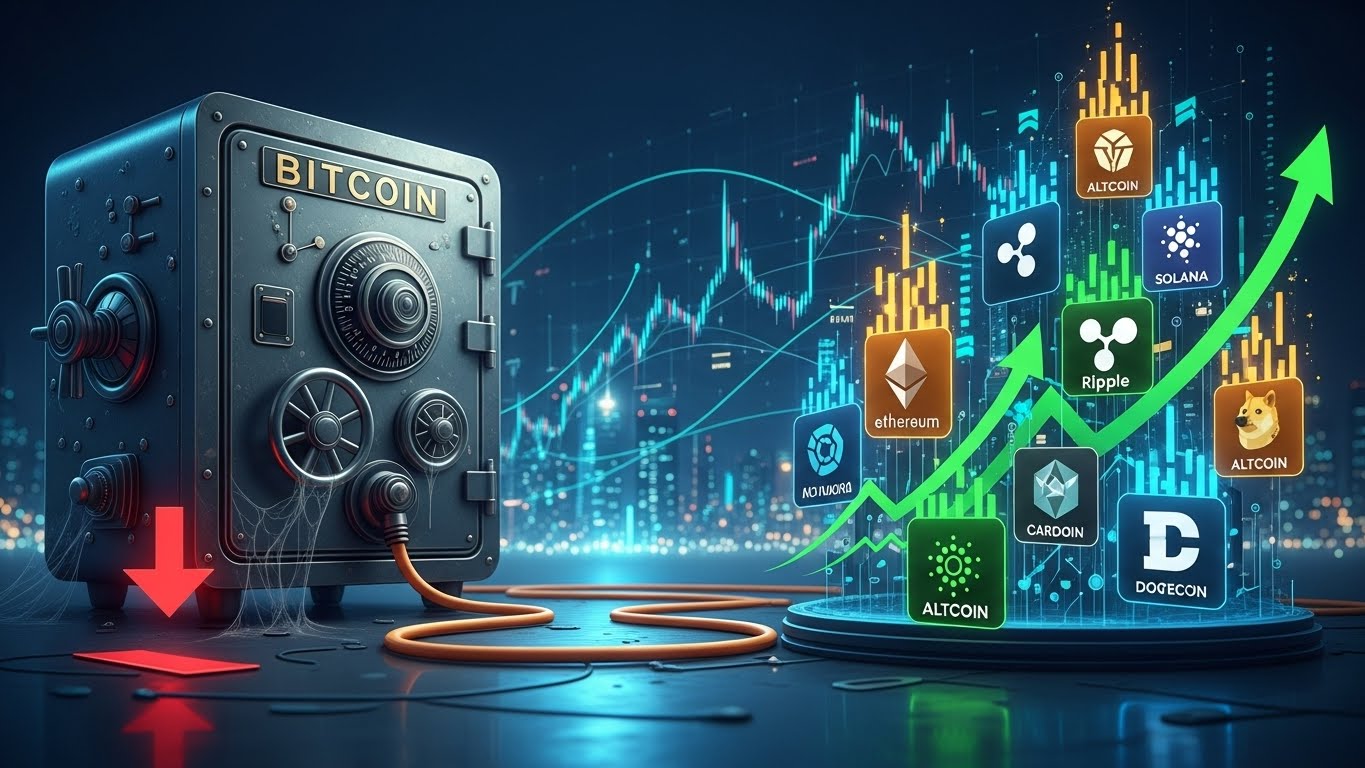
The intriguing twist in this phase is that while Bitcoin sentiment softens, altcoin pockets are rebounding. This may seem counterintuitive at first. If the flagship asset is struggling, shouldn’t smaller coins suffer even more? In practice, the opposite can occur in specific periods due to capital rotation.
When traders perceive Bitcoin upside as limited in the short term, they often look elsewhere for higher potential returns. That doesn’t always mean leaving the crypto market entirely. Instead, they rotate into select altcoins with compelling catalysts, lower market caps, or more dramatic volatility. This rotation is a classic pattern in speculative markets: when the leader consolidates, capital explores the edges.
This is why you may see Bitcoin dominance plateau or even dip while certain DeFi tokens, layer-2 solutions, or AI-focused altcoins begin to trend upward. Traders don’t suddenly become risk-averse; they simply become more selective about where they believe the next leg of growth might appear.
Narrative-Driven Altcoin Rallies
Altcoins rarely move in unison. Instead, altcoin rallies tend to cluster around strong narratives. One sector might be driven by yield opportunities in decentralized finance, another by scaling solutions for Ethereum, and yet another by hype cycles around meme coins or gaming tokens.
When Bitcoin sentiment is weak, these narratives gain outsized importance. If traders don’t see a clear technical breakout on Bitcoin’s chart, they become more willing to punt on stories like “this ecosystem is capturing real users,” “this protocol has a new upgrade,” or “this chain is attracting liquidity.” Even if the fundamentals are mixed, the promise of asymmetric upside can attract speculative flows.
This is how altcoin pockets can rebound even in a cautious macro environment. Capital doesn’t need every altcoin to perform; it only needs a handful of clear, tradeable trends. For observers, it can look like a contradiction—Bitcoin is “dead” again, yet certain altcoins are up 30%, 50%, or more in a week.
The Data Behind Diverging Sentiment
Funding, Open Interest, and Liquidity
Under the hood, derivatives data often tells the story of how sentiment is shifting. When Bitcoin sentiment breaks down, you’ll typically see:
Perpetual futures funding rates are turning more neutral or negative as long positions get flushed out and shorts grow bolder.
Open interest is declining as overleveraged positions are cleared, leaving a cleaner slate but also less aggression.
Liquidity thins around higher price levels, reflecting fewer market makers willing to support impulsive breakouts.
In contrast, when altcoins rebound, you might notice funding rates spike on specific pairs, indicating aggressive longs chasing a breakout. Liquidity becomes more fragmented, as capital leaves major pairs like BTC/USDT and flows into niche altcoin markets. This creates fast, sharp moves that can be exhilarating but also dangerous.
These divergences reinforce the idea that Bitcoin sentiment weakness doesn’t mean all risk appetite has vanished. Instead, it is reorganizing itself, favoring selective, speculative plays over broad-based conviction in the crypto benchmark.
Wallet Behavior and Whale Activity
On-chain, changing sentiment can also be traced through wallet activity. When long-term Bitcoin holders begin sending coins to exchanges, it can signal a readiness to take profits or reduce exposure, echoing softer sentiment. Conversely, periods of quiet accumulation by whale wallets and long-term holders may indicate that while short-term sentiment is broken, deeper conviction remains intact.
For altcoins, bursts of activity in smart contract interactions, increased network usage, or rising unique addresses can all support a case for a sustained altcoin rebound rather than a purely speculative pump. However, traders must be careful; many altcoin surges happen on thin liquidity and can reverse quickly when early buyers decide to exit.
By combining on-chain data, derivatives metrics, and spot volume trends, investors can better understand whether the divergence between Bitcoin sentiment and altcoin performance is likely to be short-lived or part of a longer rotation.
What the Split Means for Traders and Investors

Short-Term Traders: Volatility with a Side of Trap
For active crypto traders, shattered Bitcoin sentiment and rebounding altcoins present both opportunity and danger. On one side, reduced conviction in Bitcoin can lead to range-bound price action that favors mean-reversion strategies and shorter time frames. On the other hand, surging altcoins can deliver outsized wins if traders catch the move early.
The trap comes from overestimating how long a given altcoin trend will last. Many traders jump into parabolic moves late, driven by FOMO and social media hype, only to be left holding the bag when liquidity dries up. In an environment where Bitcoin is consolidating, and sentiment is fragile, any sudden risk-off event—such as a regulation scare or macro shock—can hit altcoins brutally hard.
Smart traders focus on clear setups, defined invalidation levels, and disciplined risk management. They treat narratives and hype as background context, not as primary entry signals. Instead of betting the portfolio on a single trending token, they allocate modestly, scale positions, and remain willing to cut losers quickly.
Long-Term Investors: Zooming Out on the Noise
For long-term Bitcoin investors and diversified crypto holders, broken short-term sentiment often presents as noise rather than an existential threat. Many seasoned investors recognize that every cycle has phases where narratives flip wildly between “Bitcoin is dead” and “Bitcoin is inevitable”. The truth tends to lie somewhere in between, expressed over years rather than weeks.
From a strategic perspective, a period where Bitcoin sentiment is shattered can be a chance to reassess the thesis, not to panic. If your long-term view is that Bitcoin remains a core digital store-of-value asset or a hedge against certain macro outcomes, temporary sentiment shifts may offer opportunities for accumulation, rather than forced exits.
However, long-term investors must also be honest about allocation to high-risk altcoins. Just because altcoin pockets rebound doesn’t guarantee those projects will survive the next downturn. A thoughtful approach prioritizes Bitcoin and a small set of fundamentally stronger altcoins, rather than chasing every new trend.
Could Altcoins Lead the Next Cycle?
Historical Patterns: Bitcoin First, Altcoins Later
Historically, many crypto cycles have followed a pattern: Bitcoin leads initial recovery, establishes a trend, and only then do altcoins outperform in what traders label altseason. This has created the expectation that Bitcoin must always be strong first before altcoins can sustainably rally.
But markets evolve. Institutional products, changing liquidity conditions, and the rapid experimentation of Web3, DeFi, and NFT ecosystems have complicated the picture. It’s now more feasible for pockets of altcoin strength to appear even when Bitcoin sentiment is middling or outright negative in the short term, especially when new narratives are compelling.
Still, for a full-blown altcoin supercycle to unfold, Bitcoin typically cannot remain weak indefinitely. Most large players still view Bitcoin as the anchor asset of the entire crypto complex. If that anchor were to break decisively, overall risk appetite could collapse, dragging altcoins down regardless of short-term rebounds.
Scenarios for the Months Ahead
From today’s split between shattered Bitcoin sentiment and rebounding altcoins, several broad scenarios can unfold:
Bitcoin stabilizes, grinds higher, and gradually restores sentiment, while altcoins that proved themselves during the shaky phase become new cycle leaders.
Bitcoin enters a deeper correction, pulling liquidity out of speculative altcoins and turning current rebounds into bull traps.
Bitcoin ranges for an extended period, during which time capital continuously rotates between different altcoin sectors, generating rolling mini-cycles.
No one can predict with certainty which path will dominate. What investors can do is build a flexible framework: monitor Bitcoin dominance, track where volume and developer activity are flowing, and stay aware that today’s rebound could be either the beginning of something larger or just another short-lived spike in a choppy market.
Reading Sentiment Without Getting Trapped
Combining Technicals, Fundamentals, and On-Chain Data
To avoid being whipsawed by changing crypto sentiment, traders should resist relying on a single type of analysis. Chart patterns alone can mislead when driven by thin liquidity. Headlines alone can distort understanding when they focus on extremes. Social media alone tends to amplify emotion, not clarity.
A more balanced approach blends:
Price action and technical analysis to identify trend, support, resistance, and volatility regimes.
Fundamental views on protocol design, tokenomics, and ecosystem growth for each altcoin are considered.
On-chain metrics for both Bitcoin and altcoins, such as HODL waves, exchange flows, and network usage.
By triangulating across these dimensions, it becomes easier to see when Bitcoin sentiment is merely shaking out leverage versus when it might be signaling a more serious structural shift. Likewise, it becomes easier to distinguish healthy altcoin rebounds supported by real usage from purely speculative spikes that lack substance.
Managing Emotions: FOMO, Panic, and Patience
Ultimately, sentiment is as much about psychology as it is about data. When headlines scream that Bitcoin is done and your feed is full of “next 100x altcoin” promises, it’s easy to be pulled off your strategy. This is where emotional discipline matters most.
The key is to define your time horizon, risk tolerance, and thesis in advance. If you’re a short-term trader, accept that volatility and quick trend reversals are part of the game, and size positions accordingly. If you’re a long-term investor, accept that bearish sentiment and wild altcoin surges are inevitable along the journey, and that they don’t necessarily invalidate your thesis.
Avoid making large decisions purely in response to shattered Bitcoin sentiment or glowing altcoin rebound stories. Instead, treat them as signals to review your analysis, confirm your assumptions, and decide whether existing positions still align with your plan. The more your decisions are anchored in a coherent framework rather than emotional reactions, the less likely you are to be caught on the wrong side of sentiment swings.
Conclusion
The current landscape, where Bitcoin sentiment is shattered as altcoin pockets rebound, can feel chaotic. On one side, the largest and most established crypto asset struggles to break higher, weighed down by macro concerns, regulation anxiety, and emotional fatigue. On the other hand, selective altcoins surge on fresh narratives, attracting traders hungry for higher returns and faster moves.
Beneath the noise, however, the underlying dynamics are familiar. Capital rotation, shifting narratives, and cyclical sentiment are hallmarks of the crypto market. Understanding how and why Bitcoin sentiment can diverge from altcoin performance is not just an academic exercise—it’s a practical edge.
By focusing on data instead of drama, maintaining disciplined risk management, and aligning decisions with a clear time horizon, you can navigate an environment where Bitcoin stalls while altcoins shine. Sometimes the best move is to step back, refine your strategy, and remember that sentiment—no matter how shattered or euphoric—tends to be temporary. What endures is the strength of your framework and the patience with which you apply it.