Ethereum News Today: ETH Fails to Hold $3K Amid ETF Outflows, Underperforms Market
Ethereum news today as ETH fails to hold $3K amid ETF outflows, weak demand, and broader market strength elsewhere. Full ETH price analysis.


Ethereum news today is dominated by renewed weakness in ETH price action as the world’s second-largest cryptocurrency once again failed to hold the critical $3,000 psychological level. While the broader crypto market shows signs of stabilization and selective strength, Ethereum has continued to underperform, weighed down by persistent ETF outflows, declining on-chain momentum, and growing competition within the smart contract ecosystem.
The inability of ETH to sustain rallies above $3K has raised concerns among investors, particularly as Bitcoin and several large-cap altcoins demonstrate relative resilience. Market participants are now questioning whether Ethereum’s fundamentals are temporarily lagging or if deeper structural challenges are emerging in the short to medium term.
In this detailed Ethereum news today analysis, we explore why ETH is struggling, how ETF outflows are shaping sentiment, what technical indicators suggest, and whether Ethereum can reclaim its leadership position in the crypto market. We also examine broader macroeconomic influences, regulatory developments, and network-level metrics that are influencing Ethereum’s current trajectory.
Ethereum Price Today Struggles Below the $3,000 Level
Ethereum price today reflects a market caught between long-term optimism and short-term uncertainty. After multiple attempts to reclaim the $3,000 level, ETH has repeatedly faced strong selling pressure, pushing it back into a consolidation range below this key threshold.
The $3K level has become more than just a round number. It represents a psychological barrier that traders and institutions closely monitor. Each failed breakout reinforces bearish short-term sentiment, encouraging profit-taking and short selling. This dynamic has kept Ethereum price action weaker compared to Bitcoin, which has managed to defend its own key support zones more effectively.
From a market structure perspective, Ethereum has been forming lower highs on shorter time frames, signaling reduced buying conviction. While long-term holders remain largely intact, short-term traders appear hesitant to commit capital amid ongoing uncertainty surrounding Ethereum ETF flows and broader macroeconomic conditions.
ETF Outflows Continue to Weigh on Ethereum Sentiment
Ethereum ETF Outflows Signal Cautious Institutional Behavior
One of the most significant factors shaping Ethereum news today is the sustained outflow from Ethereum-related ETFs. Since their launch, Ethereum ETFs were expected to mirror the success of Bitcoin ETFs by attracting steady institutional capital. However, recent data shows that ETH ETFs have experienced net outflows during several trading sessions.
These ETF outflows suggest that institutional investors are either reducing exposure or reallocating capital toward assets perceived as having stronger near-term momentum. In contrast to Bitcoin, which benefits from a clear narrative as digital gold, Ethereum’s investment thesis is more complex, encompassing smart contracts, decentralized finance, staking, and scaling solutions. This complexity, while a long-term strength, can also create hesitation during periods of macro uncertainty. Institutions tend to favor simplicity and liquidity during risk-off phases, which has placed Ethereum at a relative disadvantage.
Impact of ETF Flows on ETH Price Performance
ETF flows play a crucial role in shaping short-term price dynamics. When ETFs experience consistent outflows, the underlying asset often faces additional selling pressure as fund managers rebalance holdings. For Ethereum, this has translated into increased volatility and weaker price recovery attempts.
Moreover, negative ETF flow headlines can influence retail sentiment, reinforcing bearish narratives on social media and trading platforms. This feedback loop has contributed to Ethereum underperforming the broader crypto market despite no major deterioration in its core fundamentals.
Ethereum Underperforms the Broader Crypto Market
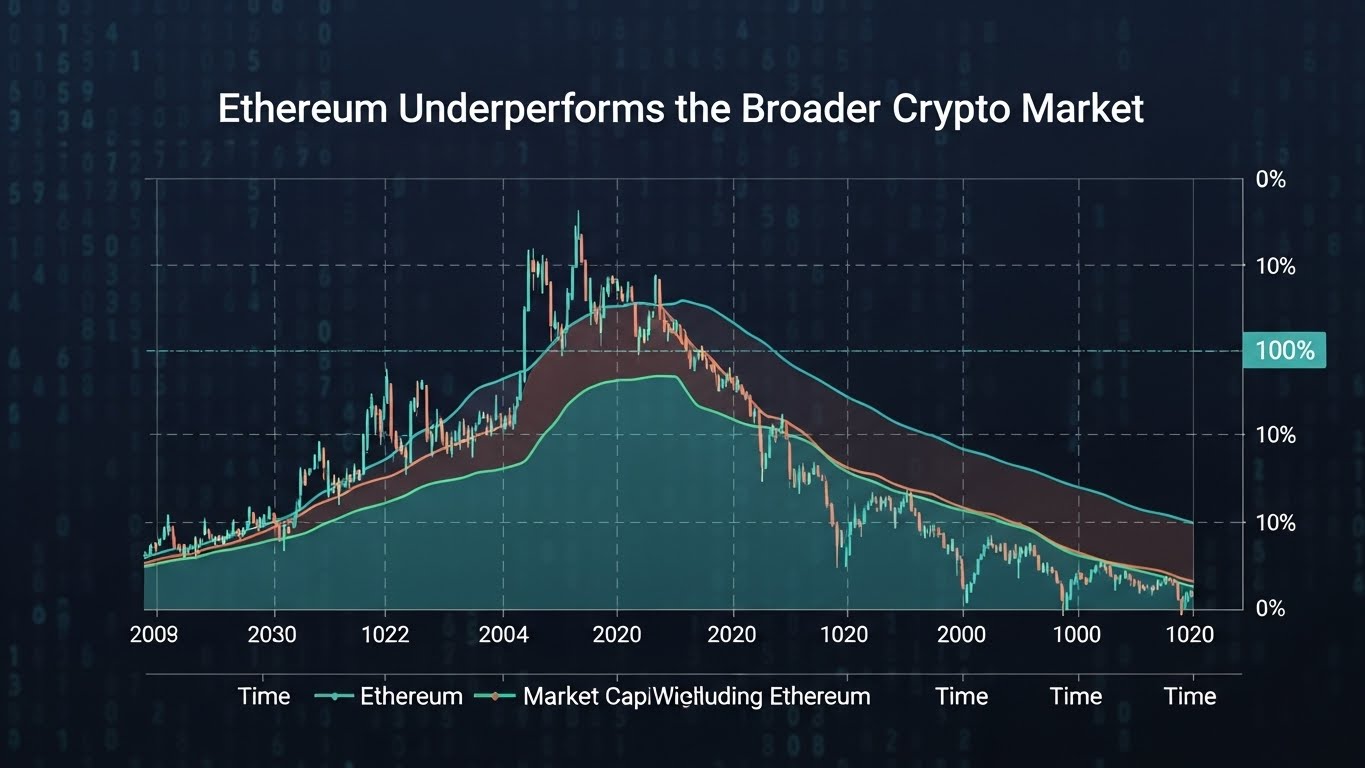
Ethereum underperformance has become increasingly evident when compared to both Bitcoin and select altcoins. While BTC has benefited from strong institutional narratives and macro hedging demand, Ethereum has struggled to attract similar levels of enthusiasm in recent weeks. Altcoins within specific sectors, such as artificial intelligence tokens and layer-2 scaling solutions, have also outpaced ETH in percentage gains. This rotation suggests that capital is flowing toward higher-beta opportunities or clearer thematic plays rather than the more established Ethereum ecosystem.
The relative weakness of ETH is particularly notable given its central role in decentralized finance and NFTs. Historically, Ethereum has often led market recoveries. Its current lag raises questions about whether investors are reassessing its short-term growth potential amid evolving competition from alternative smart contract platforms.
Ethereum Support Zones Remain Under Pressure
From a technical standpoint, Ethereum price today is hovering near critical support levels that have been tested multiple times. The area between $2,800 and $2,900 has emerged as a key demand zone, with buyers stepping in to prevent deeper declines. Repeated tests of support, however, can weaken its effectiveness. If ETH fails to hold this range convincingly, the next major support could lie closer to the $2,600 region, where longer-term moving averages converge. Such a move would likely trigger increased volatility and heightened fear across the Ethereum market.
Resistance at $3,000 Continues to Cap Upside
On the upside, the $3,000 level remains a formidable resistance. Beyond this, the $3,200 zone represents another critical hurdle where previous rallies have stalled. Breaking above these levels would require a decisive shift in market sentiment, potentially driven by positive ETF inflows or broader risk-on conditions.
Technical indicators such as the Relative Strength Index and moving averages suggest that Ethereum is currently in a neutral-to-bearish short-term trend. However, longer-term indicators still point to a broader bullish structure, highlighting the disconnect between short-term price action and long-term fundamentals.
On-Chain Data Shows Mixed Signals for Ethereum
Network Activity Remains Stable but Not Expanding Rapidly
On-chain metrics provide additional context to Ethereum news today. Transaction volumes, active addresses, and gas usage have remained relatively stable, indicating that the network continues to function as a core infrastructure layer for decentralized applications.
However, growth in these metrics has slowed compared to previous bullish phases. This moderation suggests that while Ethereum usage remains robust, it is not currently experiencing the explosive expansion that often accompanies strong price rallies. Staking participation remains high, with a significant portion of ETH locked in validator contracts. This reduces circulating supply but also limits liquidity, which can exacerbate price swings during periods of heightened selling pressure.
Whale Behavior Reflects Cautious Optimism
Large Ethereum holders, commonly referred to as whales, have shown mixed behavior. Some have increased accumulation near support levels, signaling confidence in Ethereum’s long-term value. Others have reduced exposure, possibly hedging against further downside or reallocating capital elsewhere. This divergence underscores the current uncertainty in the Ethereum market. While long-term believers remain committed, short-term positioning remains cautious, contributing to sideways price action.
Macro Factors Influencing Ethereum Price Today
Broader macroeconomic conditions continue to influence cryptocurrency markets, and Ethereum is no exception. Expectations around interest rate policy, inflation data, and global liquidity conditions have a direct impact on risk assets, including digital currencies. When yields rise or the U.S. dollar strengthens, speculative assets like Ethereum often face headwinds. Recent macro data has reinforced a cautious outlook, prompting investors to reduce exposure to higher-risk assets. This environment has disproportionately affected Ethereum due to its more complex value proposition compared to Bitcoin.
Ethereum News today regulatory developments also play a role. While Ethereum has largely avoided the regulatory scrutiny faced by some altcoins, uncertainty around staking regulations and ETF structures continues to create overhangs that limit upside momentum.
Competition From Layer-2 and Alternative Blockchains

Layer-2 Solutions Shift Value Capture Dynamics
Ethereum’s scaling roadmap relies heavily on layer-2 networks, which have seen rapid growth in adoption. While this is positive for the ecosystem as a whole, it has altered value capture dynamics for ETH itself.
Transaction fees on the main Ethereum network have declined as activity migrates to layer-2 solutions. Although this improves user experience, it reduces direct fee revenue for Ethereum, impacting narratives around ETH as a yield-generating asset.
Rival Blockchains Attract Speculative Capital
Alternative smart contract platforms continue to compete aggressively for developers and users. Faster transaction speeds, lower fees, and targeted incentive programs have drawn speculative capital away from Ethereum during certain market phases. While Ethereum still dominates in terms of total value locked and developer activity, short-term traders often chase momentum elsewhere. This rotation has contributed to Ethereum underperforming the market in recent weeks.
Market Sentiment and Investor Psychology
Investor sentiment around Ethereum is currently cautious but not outright bearish. Social media sentiment analysis suggests a decline in bullish commentary, replaced by neutral or wait-and-see attitudes. This shift reflects fatigue after multiple failed breakout attempts above $3,000.
Psychologically, repeated rejection at key levels can erode confidence, even among long-term holders. However, such periods of consolidation have historically preceded significant moves once sentiment resets and new catalysts emerge. Ethereum news today highlights a market searching for direction rather than capitulating, which may ultimately prove constructive for longer-term investors.
What Could Trigger a Reversal for Ethereum?
Several catalysts could help Ethereum regain momentum. A reversal in Ethereum ETF outflows, with sustained inflows signaling renewed institutional interest, would be a major positive development. Additionally, broader risk-on conditions driven by accommodative monetary policy could lift the entire crypto market.
Network upgrades, improvements in layer-2 interoperability, and renewed growth in decentralized finance could also strengthen Ethereum’s fundamental narrative. If these developments coincide with favorable macro conditions, ETH could break above key resistance levels and reassert leadership. Until such catalysts materialize, Ethereum may continue to trade in a range, frustrating both bulls and bears.
Conclusion
Ethereum news today paints a picture of a market at a crossroads. ETH’s failure to hold the $3,000 level amid ongoing ETF outflows has underscored its short-term challenges, even as long-term fundamentals remain largely intact. Underperformance relative to the broader crypto market reflects shifting investor preferences and macro uncertainty rather than a collapse in Ethereum’s core value proposition.
For investors and traders, the current environment demands patience and careful risk management. Ethereum’s history suggests that periods of consolidation and doubt often precede powerful moves. Whether the next major move is higher or lower will depend on ETF flows, macro conditions, and the network’s ability to sustain growth. As always, Ethereum remains one of the most closely watched assets in the crypto space, and its next chapter is likely to have far-reaching implications for the broader market.
FAQs
Q. Why is Ethereum failing to hold the $3,000 level?
Ethereum is struggling to hold $3,000 due to a combination of ETF outflows, cautious institutional sentiment, macroeconomic headwinds, and reduced short-term buying pressure.
Q. How do ETF outflows affect Ethereum price?
ETF outflows increase selling pressure and negatively impact sentiment, often leading to weaker price performance as institutional capital temporarily exits the asset.
Q. Is Ethereum underperforming compared to Bitcoin?
Yes, Ethereum has underperformed Bitcoin recently, as BTC benefits from stronger institutional narratives and clearer positioning as a macro hedge.
Q. Are Ethereum fundamentals still strong?
Despite short-term price weakness, Ethereum’s fundamentals remain solid, with stable network activity, high staking participation, and continued developer engagement.
Q. Could Ethereum recover above $3,000 soon?
A recovery above $3,000 is possible if ETF flows turn positive, macro conditions improve, or new catalysts reignite investor confidence in the Ethereum ecosystem.