Mining Bitcoin US Questions Bitmain Over Espionage
The U.S. raises security concerns over Bitmain’s role in mining Bitcoin, sparking debate about espionage, hardware risks, and the future of crypto mining.

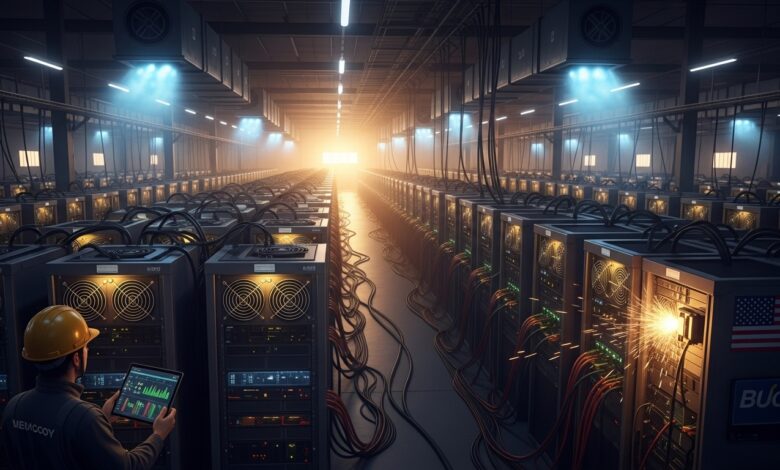
Mining Bitcoin has transformed from a niche digital hobby into a global industrial powerhouse. With billions of dollars at stake, vast data centers, and global energy considerations, what once began as an open-source experiment now sits at the crossroads of geopolitics, cybersecurity, and international rivalry. Mining Bitcoin US. As industrial-scale mining becomes deeply intertwined with national infrastructure, governments cannot ignore the implications of who controls the hardware, software, and energy pathways that power the Bitcoin network.
It is in this charged environment that Bitmain, the world’s most influential manufacturer of Bitcoin mining hardware, has come under heightened scrutiny in the United States. Officials, lawmakers, and analysts have begun questioning whether the company’s dominance in the ecosystem introduces strategic vulnerabilities. Although no public evidence directly accuses Bitmain of espionage, the suspicions reflect broader tensions surrounding Chinese technology firms and their participation in critical American infrastructure. As more mining facilities shift into U.S. territory, and as concerns about cybersecurity align with international power struggles, Bitmain is now a central figure in a debate that goes far beyond Bitcoin itself.
How Mining Bitcoin Became a Geopolitical Flashpoint
Mining Bitcoin initially seemed detached from geopolitical dynamics. During its early years, individuals mined coins from laptops and personal computers. However, as Bitcoin grew more valuable, the difficulty of mining increased exponentially, forcing miners to adopt advanced hardware and expand into industrial-scale operations. The very nature of Bitcoin mining changed, evolving into a global competition for high-performance chips, large-scale data centers, and access to cheap, stable sources of electricity.
This transformation elevated mining Bitcoin into an issue of national interest. Mining farms today are essentially specialized data centers, packed with thousands of ASIC machines that consume enormous amounts of energy and connect to global networks. Their presence impacts electrical grids, local communities, technological supply chains, and, increasingly, the national security apparatus of major economies.
For the United States, the shift in Bitcoin mining geography is especially significant. China dominated global hashrate until 2021, when the Chinese government abruptly restricted mining. Overnight, the center of gravity relocated, with American states like Texas, Kentucky, and Wyoming embracing mining farms at an unprecedented pace. The U.S. now controls a substantial share of the global Bitcoin hashrate. Yet the hardware powering this hashrate overwhelmingly comes from Chinese firms, with Bitmain leading the pack.
This dependency is what fuels much of the current concern. To policymakers, relying on foreign-made machines that form the backbone of large U.S.-based data centers introduces a strategic vulnerability. Mining Bitcoin is now viewed not only as an economic activity but also as an element of national technological infrastructure—one that must be protected from foreign influence and potential surveillance.
Bitmain’s Dominance in Bitcoin Mining

To understand why U.S. scrutiny centers on Bitmain, one must first appreciate the company’s enormous influence. Founded in 2013 in China, Bitmain rose to prominence due to its Antminer series, a line of specialized ASIC miners engineered to perform Bitcoin’s SHA-256 hashing at exceptional speeds with remarkable energy efficiency. As Bitcoin mining shifted from CPUs to GPUs and ultimately to ASICs, Bitmain arrived at precisely the right moment to dominate the emerging market.
Bitmain’s success came from several factors that rivals struggled to replicate. Its engineering teams continually pushed the limits of chip design, creating miners that were significantly more powerful and efficient each generation. Partnerships with high-end semiconductor foundries allowed Bitmain to secure production capacity, while its global distribution network ensured its machines reached miners quickly. The firm also expanded into mining pools, firmware development, and hosting services, achieving a degree of vertical integration unparalleled in the industry.
This influence extended far beyond China. When miners in the United States began scaling up their operations, Bitmain was often their first and only choice. From small operations in rural warehouses to massive mining farms in Texas drawing hundreds of megawatts of electricity, Bitmain’s Antminers became the backbone of the American mining boom. Even after leaving China due to regulatory pressure, Bitmain maintained global dominance, relying on international logistics hubs, U.S.-based assembly lines for tariff mitigation, and partnerships with North American hosting companies.
At its peak, Bitmain was estimated to supply a large majority of the world’s mining hardware. This near-monopoly on crucial Bitcoin infrastructure is precisely what alarms U.S. officials today.
Why U.S. Officials Are Nervous About Bitmain
To understand suspicions of espionage, one must recognize the broader U.S. posture toward Chinese technology firms. Over the past decade, concerns about cybersecurity, supply-chain manipulation, forced technology transfer, and state influence over private companies have reshaped America’s policy toward Chinese tech giants. The controversies involving Huawei, ZTE, TikTok, and major semiconductor companies reflect a broader pattern in which the U.S. views Chinese involvement in critical tech infrastructure with deep skepticism.
Bitmain fits into this pattern not because of clear evidence of wrongdoing but because of what it represents: a foreign company—with perceived proximity to the Chinese state—controlling key hardware deployed across U.S. soil. The fact that mining rigs are networked, remotely manageable devices amplifies concerns. Mining farms require constant connectivity for firmware updates, remote monitoring, and coordination with mining pools. For security analysts, such connectivity introduces a theoretical attack surface that cannot be ignored.
Additionally, the physical location of mining sites has stirred anxiety. Several large mining operations linked to Chinese investors or supplied heavily by Chinese manufacturers were discovered near sensitive U.S. military installations or critical infrastructure nodes. Even if operating legitimately, their proximity raises hypothetical risks. Officials worry that data centers could theoretically house sensors, communication equipment, or cyber tools disguised among mining equipment.
In recent years, U.S. customs authorities have detained shipments of Bitmain’s mining hardware, citing regulatory compliance issues and national security concerns. These detentions disrupted the flow of thousands of machines into the country and highlighted the increasing suspicion surrounding foreign mining hardware. Legislative figures in the United States have gone so far as to call for formal investigations into Bitmain’s operations and supply chains, emphasizing concerns about transparency, corporate structure, and potential state influence.
While none of these steps confirm espionage, they show a government actively preparing for worst-case scenarios in an increasingly unstable geopolitical climate.
Do Espionage Suspicions Have Evidence Behind Them?

It is essential to approach this subject with clarity: no U.S. government agency has publicly provided evidence that Bitmain engages in espionage. The suspicions are rooted not in proven misconduct but in perceived risks. The U.S. national security community often evaluates foreign technology not by what is known to have happened, but by what could plausibly happen if vulnerabilities were exploited.
This means the accusations against Bitmain are largely precautionary. When a single foreign company supplies a vast portion of the hardware used to run a decentralized global currency, and when that company is headquartered in a rival geopolitical power, concerns naturally arise. The combination of proprietary firmware, network connectivity, and involvement in critical infrastructure leads analysts to question what might be possible under theoretical scenarios involving firmware tampering, covert communication channels, or remote shutdown functionality.
In this sense, the suspicion is forward-looking. Policymakers tend to imagine the potential consequences of a centralized hardware ecosystem controlled externally, ranging from disruption of major mining operations to attempted influence on Bitcoin consensus. Even though Bitcoin itself is resilient and decentralized, mining farms represent physical targets that can be manipulated in ways the protocol cannot inherently defend against.
Thus, while Bitmain is not accused of espionage in a legal sense, it is caught in a geopolitical landscape where strategic caution increasingly governs tech policy.
How These Concerns Impact U.S. Bitcoin Miners
The growing scrutiny around Bitmain carries real consequences for American miners. Mining Bitcoin is already a competitive and capital-intensive business. Delays in hardware shipments, regulatory restrictions, or fears of future bans introduce uncertainty into an industry where timing and predictability are crucial.
Miners relying heavily on Bitmain equipment may feel pressure to diversify their hardware sources. This is easier said than done, as alternative manufacturers remain significantly smaller, less efficient, or more expensive. Some miners have turned to firms that assemble hardware in the United States, hoping this reduces dependency on foreign supply chains. Others have begun exploring partnerships with emerging ASIC producers in allied countries.
At the same time, the compliance burden is rising. Miners now face higher expectations to document procurement channels, audit firmware, and demonstrate security-conscious operational practices. Hosting facilities must ensure that tenants, investors, or partner firms have transparent ownership structures that do not raise red flags with regulators. The need for cybersecurity monitoring, firmware authentication, and vendor risk assessments is becoming as essential as energy contracts and maintenance schedules.
This increased complexity reshapes the future landscape of mining Bitcoin in America. Those who adapt early—embracing transparency, diversifying hardware, and reinforcing cybersecurity—will be better positioned in a climate where national security concerns increasingly intersect with digital mining operations.
See More: Bitcoin Trendline Breakdown What Key Indicators Reveal
The Future of Mining Bitcoin Amid US–China Tech Rivalry
Looking forward, the friction surrounding Bitmain may influence the entire future trajectory of the Bitcoin mining industry in the United States. Several paths appear possible, each carrying profound implications.
One potential direction is the expansion of national security reviews. If mining facilities are formally classified as critical infrastructure, foreign investment in mining farmland, data centers, or hardware procurement could trigger investigation by federal committees. This would align Bitcoin mining with sectors such as telecommunications or energy infrastructure, reflecting its evolving importance.
Another possible trajectory involves the rise of domestic ASIC manufacturing. Renewed investment in semiconductor production within the U.S., supported by federal incentives, could eventually open the door to American-made Bitcoin mining hardware. Even if domestic ASICs remain years away, the desire to reduce dependency on foreign technology is growing rapidly.
Regulatory clarity may also emerge around firmware standards, supply-chain auditing, or mandatory reporting for large mining operations. Such measures would not necessarily target Bitmain directly but would reshape the environment in which all hardware vendors must operate.
The final possibility is one of continued tension without decisive action. In this scenario, Bitmain would continue supplying the American market, miners would continue deploying its hardware, and the U.S. would continue balancing economic opportunity with geopolitical risk.
Whichever path unfolds, the intersection of mining Bitcoin and national security will remain a defining issue in the evolution of the crypto-mining landscape.
Conclusion
The idea that “The United States Suspect Bitmain of Espionage” reflects more than a headline—it encapsulates a broader shift in how mining Bitcoin is perceived by governments, regulators, and strategic analysts. Bitmain’s dominance in Bitcoin mining hardware naturally places it at the center of scrutiny in an era defined by technological rivalry between the United States and China. Even in the absence of direct evidence, concerns about supply-chain vulnerabilities, firmware integrity, and proximity to sensitive infrastructure have fueled suspicions.
Bitmain, for its part, continues to deny any involvement in espionage, and no public records contradict this. Yet the mere possibility of risk is enough to reshape policies, delay shipments, complicate mining operations, and spark debates about technological sovereignty. For miners, investors, and policymakers, the prudent response lies in increased transparency, diversified supply chains, rigorous cybersecurity practices, and continued evaluation of emerging threats.
Bitcoin itself remains resilient. The network’s strength lies in its decentralization, and this chapter in the industry’s development may ultimately push mining toward greater diversity and security. In the long run, these pressures may strengthen the very decentralization Bitcoin depends on, ensuring that no single company—or country—can steer the future of mining Bitcoin.