NASA Blockchain Technology for Safer Air Travel
NASA develops blockchain technology to protect flight data, reduce cyber risks, and strengthen air traffic management for safer, smarter skies.


In modern aviation, safety isn’t only about engines, weather radar, or pilot training. It’s also about data—who can access it, whether it can be trusted, and how quickly it can be shared when every second counts. As aircraft become more connected and airspace grows more complex with drones, air taxis, and high-altitude platforms, the aviation industry is confronting a new reality: cyber risk has become a direct safety concern.
That’s why the news that NASA develops blockchain technology to enhance air travel safety and security is more than a tech headline. It signals a serious push toward strengthening trust in the digital backbone of aviation—especially in the systems that coordinate aircraft, manage flight plans, and transmit telemetry between air and ground. In January 2026, NASA reported it tested a blockchain-based system during a drone flight at NASA’s Ames Research Center in California’s Silicon Valley, aiming to protect flight data from interception or manipulation and to keep air traffic management safe from disruption.
What makes this effort especially compelling is that it’s not a theoretical lab demo. NASA Blockchain Technology test involved real-world drone operations, a simulated unmanned aircraft environment, a ground control station, and a security infrastructure designed to prove that blockchain can transmit and store critical information in real time—without relying on a single central database.
Why aviation urgently needs stronger data trust
Aviation is already one of the safest ways to travel, but the systems that keep it safe are evolving. Today’s airspace depends on high-volume data exchange: flight plans, location updates, airspace constraints, operator credentials, and telemetry from aircraft and ground systems. When this information is reliable, air traffic services can coordinate safely and efficiently. When it’s not, the consequences can range from delays and confusion to dangerous operational decisions.
NASA’s own framing is direct: for airspace operations to remain safe, stakeholders must trust that data is reliable and transparent, and evolving cyber threats require new approaches. This is a critical point. Traditional cybersecurity often focuses on perimeter defenses—keeping intruders out. But aviation increasingly needs “assume breach” resilience, where systems remain trustworthy even if parts of the network are probed, spoofed, or compromised.
This is where the idea that NASA develops blockchain technology to enhance air travel safety and security becomes strategically significant. Blockchain isn’t just about cryptocurrencies. In a safety-critical context, it’s a method for maintaining data integrity, tamper resistance, and verifiable records of “who changed what and when,” especially across multiple organizations that may not share a single centralized database.
What NASA tested: blockchain for protecting flight data
NASA’s reported demonstration focused on securing digital transactions and data exchange across multiple systems and operators. In the flight test at NASA Ames, researchers used a blockchain-based system to protect flight data and to prevent data transferred between aircraft and ground stations from being intercepted or manipulated.
A core element here is that NASA described blockchain as a decentralized database that shares information across a network and records and verifies every change to a dataset—helping keep data safe, accurate, and trustworthy. That “every change is recorded” property matters in aviation because it supports auditing, forensics, accountability, and rapid conflict resolution when multiple feeds disagree. 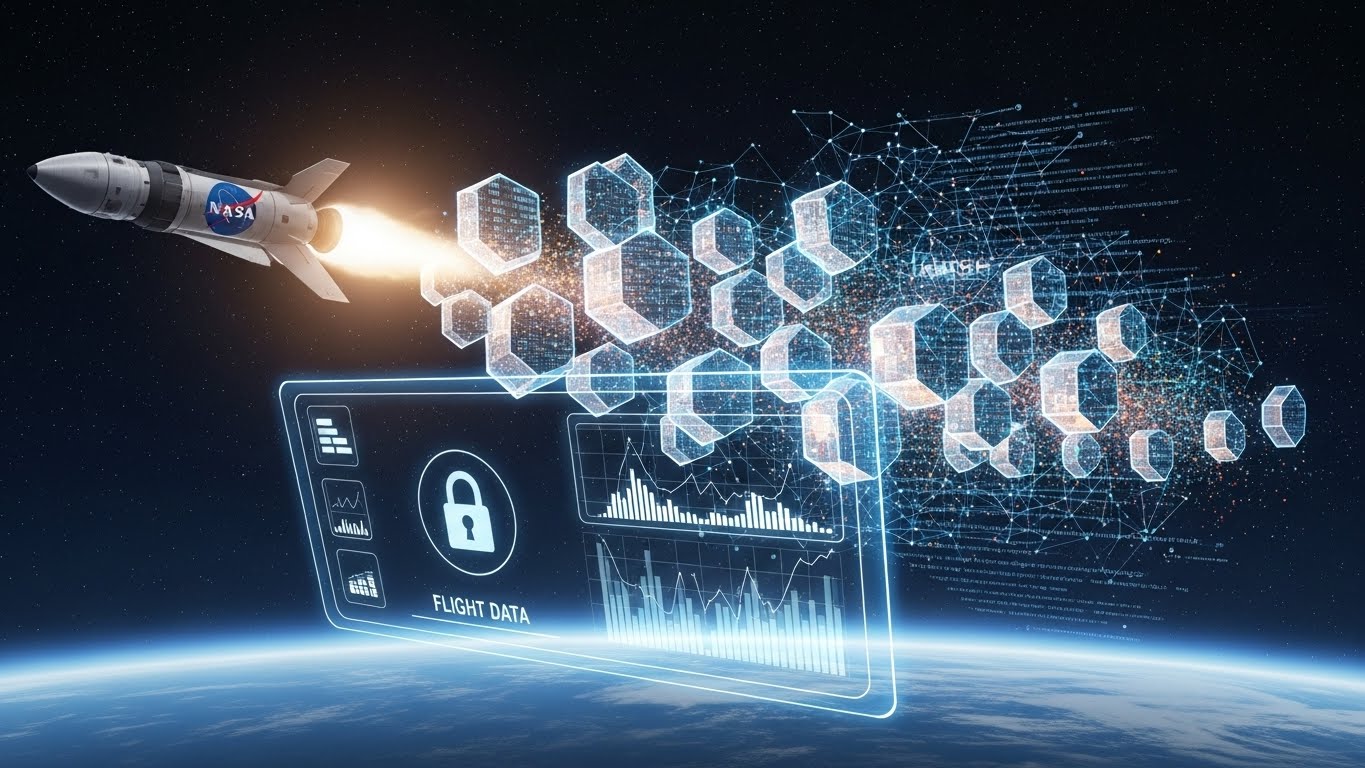
NASA also emphasized that prior cybersecurity research often centered on layered security architectures with multiple physical and digital controls, while this test explored a different approach: using blockchain to address potential threats. In other words, NASA isn’t merely adding another firewall—it’s exploring a different trust model for aviation data itself.
How blockchain improves air travel safety and security in practical terms
When people hear “blockchain,” they often think of public networks where anyone can participate. Aviation is different. Safety and security require controlled access, identity verification, and predictable performance. That’s why the most relevant model is a permissioned blockchain (also called a “trusted” or “restricted” distributed ledger), where only approved parties can validate or read certain data.
NASA’s article explains that the team used an open-source blockchain framework enabling trusted users to share and store critical data in real time—such as aircraft operator registration information, flight plans, and telemetry—while restricting access to trusted parties and approved users. That sentence is loaded with implications:
First, it supports secure data sharing among multiple stakeholders. In future airspace, coordination won’t be only between airlines and national air traffic controllers; it may include drone operators, vertiport operators, fleet managers, and service providers. Second, the approach is designed to preserve data trust even when information passes through many hands and systems. Third, the access restrictions are built into the framework, which is essential for privacy, compliance, and operational security.This is the heart of the promise when NASA develops blockchain technology to enhance air travel safety and security: you can create a shared “single source of truth” without forcing everyone into a single central database controlled by one entity.
Inside the NASA Ames drone flight test
The NASA test wasn’t simply a software simulation. The agency reported that researchers used drones to show the blockchain framework could support multiple priority aviation areas, including autonomous air traffic management, Urban Air Mobility, and high-altitude aircraft.
To assess resilience, the team introduced cybersecurity tests designed to evaluate and reinforce security during airspace operations. During an August flight at Ames, NASA demonstrated these capabilities using an Alta-X drone equipped with a custom-built software and hardware package, including a computer, radio, GPS system, and battery.
This matters for credibility. Aviation technology must work in messy real-world conditions: radio noise, intermittent connectivity, hardware constraints, and operational complexity. By validating the concept in a drone test environment, NASA is showing how blockchain-based security might behave in conditions closer to real aviation operations.
Just as importantly, NASA described how the test simulated an environment with a drone flying in real-world conditions alongside a separate ground control station and the blockchain and security infrastructure. This kind of end-to-end demonstration suggests the focus wasn’t only ledger theory—it was system integration, which is where many “promising” aviation security concepts fail.
Where blockchain fits best in aviation: trust across many stakeholders
A key reason NASA develops blockchain technology to enhance air travel safety and security is that aviation’s next era is multi-operator by default. Traditional commercial aviation is coordinated through established centralized systems and international standards. But the future is expanding into ecosystems where many independent participants interact in the same airspace: delivery drones, emergency response drones, air taxis, and potentially high-altitude operations above 60,000 feet.
NASA specifically noted that the underlying blockchain framework and cybersecurity protocols can be extended to support high-altitude operations at 60,000 feet and higher and Urban Air Mobility operations, enabling a more secure, scalable, and trusted ecosystem. The word “ecosystem” is important: a distributed ledger becomes more valuable as the number of participants grows, because it reduces the need to reconcile conflicting records from different silos.
In practical terms, a blockchain layer could help with identity and authorization, ensuring that only verified operators can submit flight intents or telemetry; data provenance, showing exactly where a record originated; and immutability, preventing quiet alteration of flight records after the fact. These are not abstract advantages—these are properties that can directly strengthen operational safety and incident investigation.
How blockchain can strengthen air traffic management without replacing it
One common misunderstanding is that blockchain would “replace” air traffic control. That’s not what NASA described. Instead, the blockchain-based system aims to keep air traffic management safe from disruption and protect flight data exchanges from interception or manipulation. That’s a security role: reinforcing the trustworthiness of the information used by controllers and automated systems. 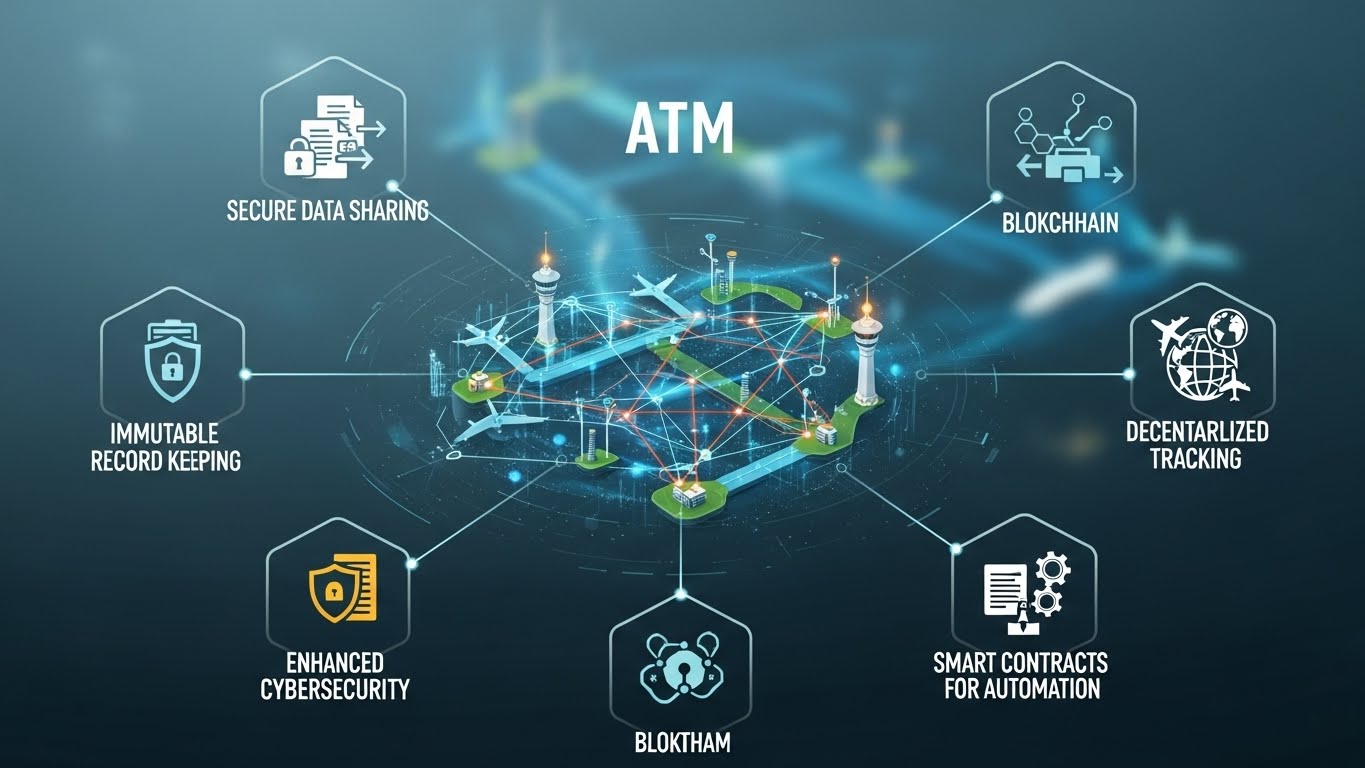
When aviation moves toward increased autonomy, the volume and velocity of data increase. Systems coordinating drones and air taxis may need near real-time validation of flight intents, constraints, and status updates. Blockchain can serve as a shared validation and audit layer—especially useful when multiple organizations must cooperate but cannot rely on one organization’s database as the sole authority.NASA also stated that researchers found the blockchain-based system can safely transmit and store information in real time. Real time is crucial: airspace decisions are time-sensitive, so a security model that only works “eventually” doesn’t help.
The role of telemetry: turning raw flight signals into trusted records
Telemetry is one of the most valuable—and vulnerable—streams in modern aviation. It includes location, velocity, system status, and other operational parameters. If telemetry is manipulated, delayed, or spoofed, decision-makers can act on false information.
NASA’s test included monitoring the flow of telemetry from both actual and simulated flights to ensure the simulation and blockchain systems processed and recorded data accurately. That detail signals a key use case: creating verifiable telemetry logs that can be trusted for situational awareness, incident response, and compliance.
In the future, when autonomous aircraft negotiate corridors, sequencing, and landing priorities, the trustworthiness of telemetry can become a gating factor for safety. If a system can reliably prove what was reported, when it was reported, and whether it was altered, that strengthens both safety operations and accountability after an event.
Why permissioned blockchain is a better fit than public blockchain for aviation
Aviation data includes sensitive operational details and must comply with regulations, privacy expectations, and national security constraints. A permissioned model enables a controlled set of validators and fine-grained access control. NASA’s description of restricting data access to trusted parties and approved users aligns directly with this requirement.
This is also why many aviation blockchain discussions emphasize governance: who runs the nodes, how identities are issued and revoked, and what rules determine what gets written to the ledger. While NASA’s public article doesn’t detail governance mechanisms, the fact that it used an open-source blockchain framework in a controlled test environment suggests the focus is on operational suitability, not open public participation.
Challenges and limitations NASA and the industry must solve
Even if NASA develops blockchain technology to enhance air travel safety and security, adopting it at scale is not automatic. Aviation systems have strict certification requirements, long lifecycles, and complex international interoperability constraints. Any new security layer must prove it improves safety without introducing fragility or performance bottlenecks.
Latency and throughput are key concerns. If every update must be validated across multiple nodes, system designers must ensure it remains fast under peak loads. There is also the matter of integration: aviation already relies on established standards, and blockchain layers must coexist with existing protocols rather than demanding unrealistic rip-and-replace transitions.
Finally, governance matters as much as cryptography. A distributed ledger is only as trustworthy as the rules and identities behind it. Permissioned systems require clear policies for who can join, who can validate, how keys are secured, and how compromised participants are removed. These aren’t reasons to dismiss blockchain in aviation—they’re the engineering realities that determine whether it becomes infrastructure or stays a pilot project.
What happens next: from flight test data to future aviation systems
NASA stated that researchers will continue analyzing the test data and apply what they learned to future work, with the goal of benefiting U.S. aviation stakeholders seeking new tools to improve operations. This suggests a pathway that looks like many NASA aeronautics innovations: demonstrate feasibility, harden the concept, validate operational fit, and then transition knowledge and technology to industry and regulators.
NASA also linked this effort to its Air Traffic Management and Safety project under the Airspace Operations and Safety Program within the Aeronautics Research Mission Directorate. That context matters because it positions blockchain not as a standalone “IT upgrade,” but as part of a broader initiative to safely accommodate growing demand and new air vehicles.
If the concept continues to prove out, expect future work to focus on scaling tests, stress-testing cybersecurity assumptions, improving interoperability, and evaluating how distributed ledger security can support dense, multi-operator airspace—especially in Urban Air Mobility corridors and advanced drone operations.
Conclusion
The phrase “NASA develops blockchain technology to enhance air travel safety and security” is not marketing hype—it reflects a concrete, flight-tested effort to protect aviation data in a world where cyber resilience is inseparable from operational safety. In its NASA Ames drone flight test, the agency demonstrated a blockchain-based system designed to prevent interception or manipulation of flight data, support real-time data transmission and storage, and reinforce trust across multiple operators and systems.
As airspace expands to include autonomous drones, Urban Air Mobility, and high-altitude platforms, aviation needs security approaches that scale across many stakeholders without depending on a single centralized trust anchor. Blockchain—especially permissioned, access-controlled distributed ledger designs—offers a promising foundation for data integrity, secure telemetry, and trusted air traffic management collaboration.
NASA’s work is still part of an evolving research journey, but its direction is clear: future aviation will run on data, and safe aviation will require that data to be provably trustworthy.
FAQs
Q: What did NASA actually do with blockchain for aviation?
NASA tested a blockchain-based system during a drone flight at NASA’s Ames Research Center to protect flight data and help prevent data exchanged between aircraft and ground stations from being intercepted or manipulated.
Q: How does blockchain improve air travel safety and security?
Blockchain can improve safety by strengthening trust in aviation data. It records and verifies changes to data across a network, helping keep records accurate, tamper-resistant, and auditable—useful for flight plans, operator credentials, and telemetry.
Q: Is NASA using public blockchain like Bitcoin?
NASA described using an open-source blockchain framework with restricted access for trusted and approved users, which aligns more closely with permissioned blockchain models used in enterprise and regulated environments.
Q: Does this mean air traffic control will be “on the blockchain”?
Not in the sense of replacing air traffic control. The goal is to secure critical data used by air traffic management and aviation stakeholders, reducing disruption risk and improving trust in shared information.
Q: When could blockchain-based aviation security be used in real operations?
NASA indicated it will continue analyzing test data and applying lessons to future work to benefit U.S. aviation stakeholders. Adoption timelines depend on further testing, standards, and regulatory validation, but the flight test is an important step toward operational readiness.
Also More: Revolutionary Blockchain Payments BMW JPMorgan Automate $1B FX Transfers